

Key facts
- Teghaza 001 was found in the Sahara in 2022, weighs about 800 grams, and takes its name from the salt flat in Mali where it was discovered.
- The rock formed more than 4.1 billion years ago and was altered by Martian water around 4.1 billion years ago.
- The in situ rubidium-strontium dating method analyzed mineral grains in a piece smaller than a fingernail and preserved the rest of the sample.
- The study identifies 13 possible source locations on Mars consistent with the meteorite’s mineralogy and chemistry.
- A separate paper on Teghaza 001’s water content was published in Science Advances in June.
Related records
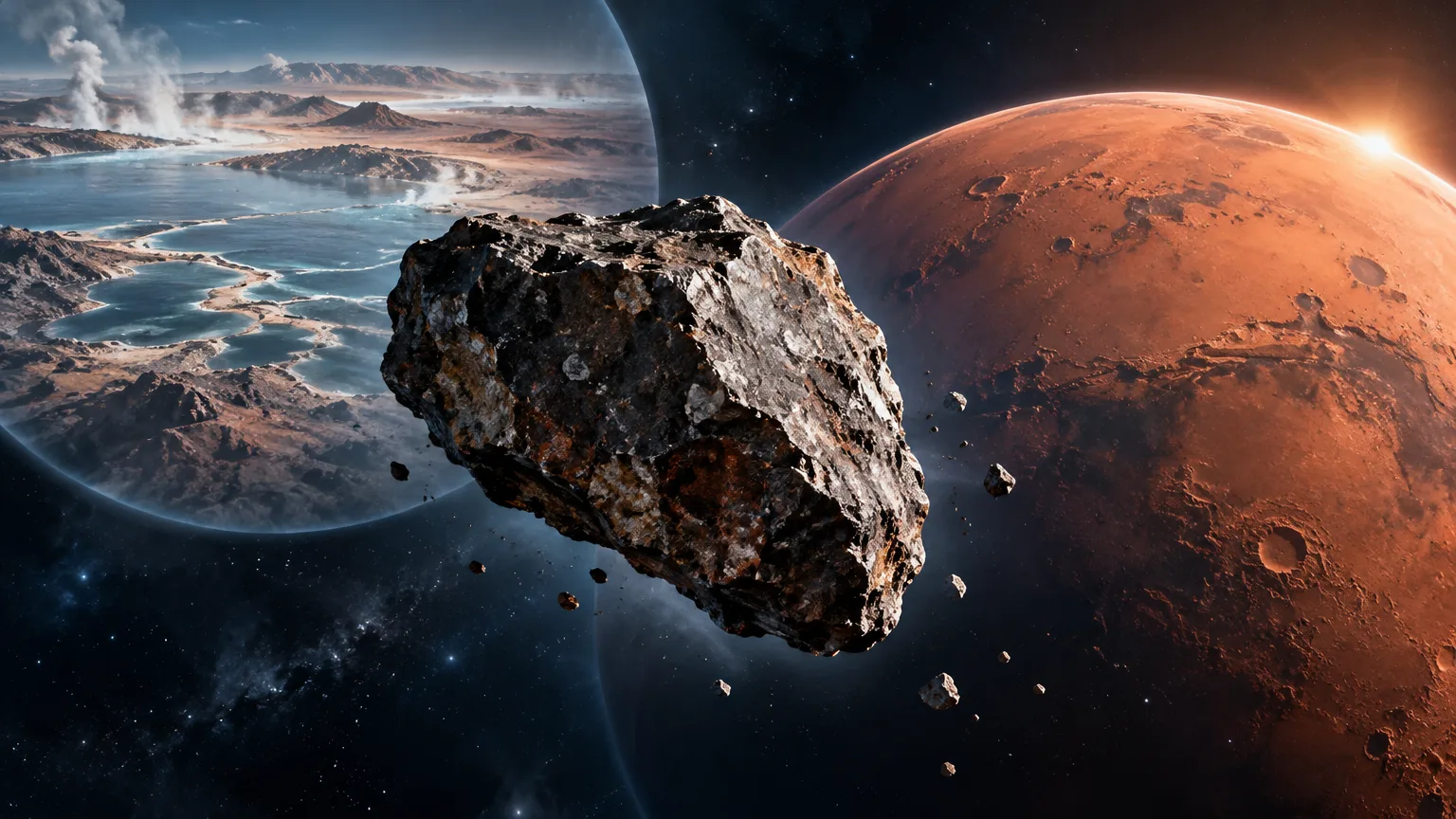
Teghaza 001 is a Martian meteorite weighing about 800 grams, found in the Sahara in 2022. It was named after the salt flat in Mali where it was discovered and is among the approximately 435 known meteorites from Mars. Its initial characterization, published in Science on a Thursday, places it among the three oldest Martian meteorites found on Earth.
The rock formed more than 4.1 billion years ago. The results indicate that Martian water altered it around 4.1 billion years ago, meaning the rock had formed earlier. Its combination of igneous minerals—originating from magma—offers clues about the formation of the ancient crust and its later modification by water beneath the surface.
A mineral mixture that offers clues
Teghaza 001 stands out for its age, texture, and assemblage of igneous minerals. Among the other two meteorites that complete the group of the three oldest is ALH84001, of similar age and composed almost entirely of a single mineral. The other, known as “Black Beauty,” formed about 2.1 billion years ago and is composed of small fragments of volcanic rock.
Teghaza 001’s mineralogy matches observations by NASA’s Mars Reconnaissance Orbiter in the cratered highlands of Mars’s southern hemisphere. The paper identifies 13 possible source locations consistent with the meteorite’s mineralogy and chemistry, but does not establish which was its point of origin.
Like other Martian meteorites, Teghaza 001 was ejected from Mars’s surface by an impact and reached Earth after traveling through space. Lee Saper, the study’s second author and a scientist at NASA’s Ames Research Center, described the rock as a record of water-rock interactions and suggested that it might also preserve a trace of the Martian atmosphere from when the planet was losing water.
Identifying and dating the sample
Researchers at the University of New Mexico identified the meteorite as Martian by comparing its oxygen isotopes with those of other meteorites from Mars. Isotopes serve as geochemical fingerprints that distinguish material from different planetary bodies. In this initial classification, Teghaza 001 appeared to belong to the shergottites, the most common class of Martian meteorites.
Lead author Yang Liu of NASA’s Jet Propulsion Laboratory (JPL) and her colleagues found unusual textures and zircon crystals. These crystals record clues about a rock’s formation and can be used to determine its age.
To date the minerals, the team used the in situ rubidium-strontium method developed by co-author François Tissot’s group at Caltech. Unlike bulk analyses, which dissolve the entire sample, this procedure used a piece smaller than a fingernail and analyzed individual mineral grains on its surface. This preserved the rest of the meteorite for future studies.
The results place the water alteration at around 4.1 billion years ago. The authors note that oxygen isotopes, texture, and mineral chemistry point to a more dynamic water cycle on early Mars.
A sample for further research
A separate paper, published in Science Advances in June, examined the water content of Teghaza 001. NASA presents the two studies as a starting point for further research into water-rock interactions on ancient Mars.
NASA explains that the mineral and chemical components of Martian meteorites can be compared with data from its Mars missions, including the Viking landers and the Curiosity and Perseverance rovers. In the case of Teghaza 001, the mineralogical match with observations from the Mars Reconnaissance Orbiter made it possible to identify possible source locations.
Lee Saper also raised the possibility that an atmospheric trace may have been preserved in the rock. That interpretation, as well as what the sample may reveal about Mars’s geological history, remains subject to further analyses by researchers.