

Key facts
- Gravity provides the centripetal acceleration that curves orbital motion.
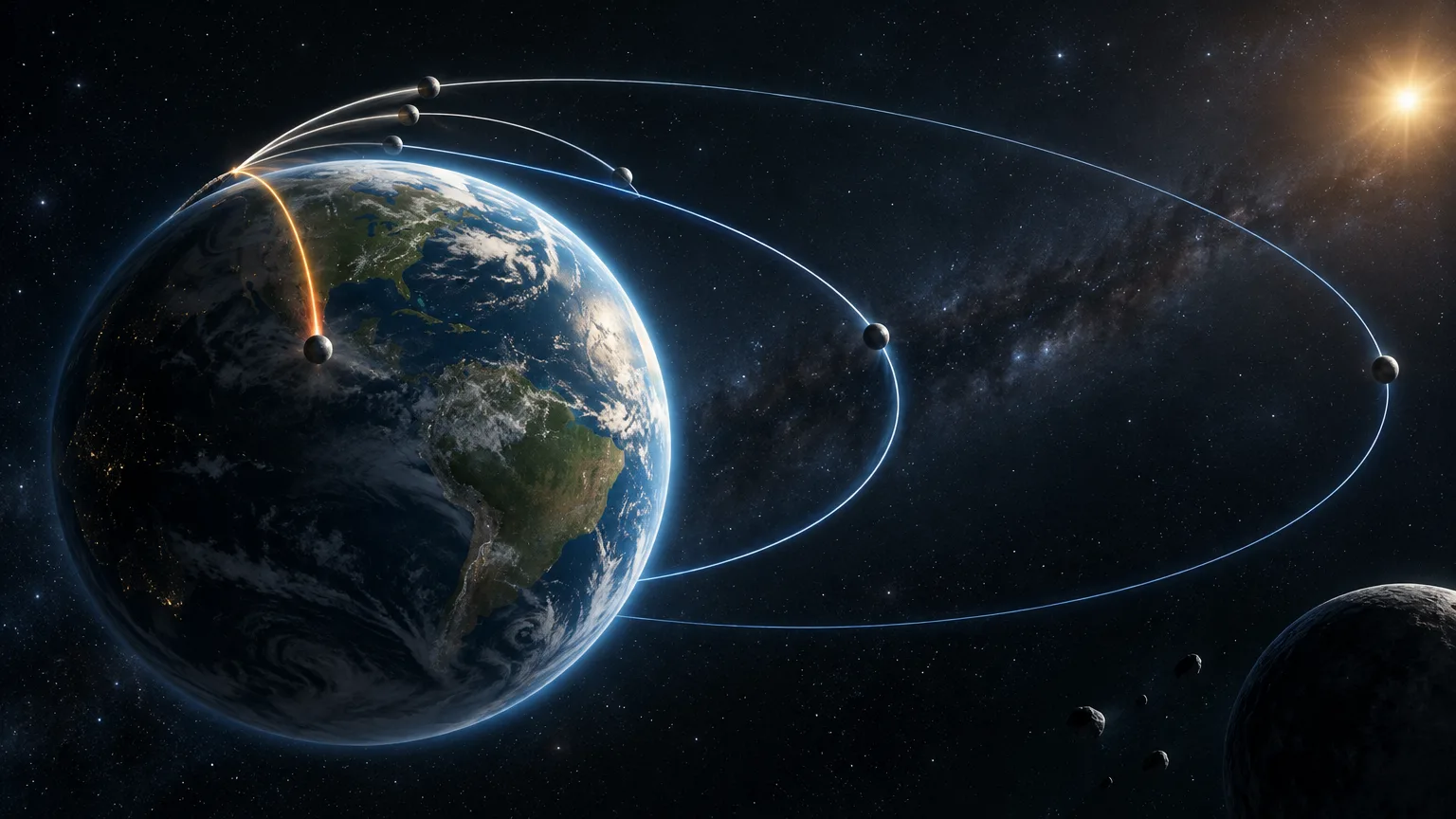
- In Newton’s cannon thought experiment, a projectile with enough speed falls around Earth without touching the surface.
- A spacecraft receives an initial push from a rocket and can use its thrusters for occasional adjustments.
- Periapsis is the closest point to the central body, and apoapsis the farthest.
- Increasing energy at apoapsis raises periapsis; increasing it at periapsis raises apoapsis.
- Aerobraking uses atmospheric drag to remove orbital energy and conserve propellant.
Related records
A spacecraft in orbit has not escaped the planet’s gravity. Gravity continues to act on it, providing the centripetal acceleration needed to curve its path. As it falls, its speed also carries it around the central body.
NASA explains this principle with Newton’s cannon thought experiment. The illustration imagines a cannon atop an extraordinarily tall mountain and simplifies the physics: it leaves aside, among other factors, atmospheric resistance and the limitations of a real cannon. The orbital mechanics it represents remain valid without those details.
From projectile to orbit
With a small initial push, the cannonball follows an arc and falls some distance away. If its speed increases, it travels farther. With enough speed, it keeps falling around the planet without touching the surface: it has reached orbit. In Newton’s example, the path is an ellipse.
A spacecraft follows the same general principle: a rocket gives it the initial push, and it then continues falling around the celestial body. Thrusters allow occasional adjustments; they do not have to remain on for the spacecraft to stay in orbit.
Gravity and free fall
To move along a curved path, an object needs acceleration toward the center of that curve. In an orbit, the mutual gravitational attraction between the central body and the object provides that centripetal acceleration.
That is why the sensation of weightlessness on board does not mean gravity has disappeared. The spacecraft and its occupants fall together in free fall, while gravity continues to curve their orbital motion.
Periapsis, apoapsis, and orbital adjustments
In an elliptical orbit, the distance from the central body varies. Periapsis is the closest point and apoapsis the farthest. These are general terms; specific names are used depending on the body being orbited, such as perigee and apogee for Earth, and perihelion and aphelion for the Sun.
The energy a spacecraft adds or removes at different points changes the shape of its path. According to NASA’s explanation, increasing energy at apoapsis raises periapsis; increasing it at periapsis raises apoapsis. Reducing energy at either of these points lowers the altitude of the opposite point. These maneuvers can be performed by firing the onboard thrusters.
It is also possible to remove orbital energy by deliberately and carefully entering the atmosphere and using drag. This technique is called aerobraking; NASA notes that it has been used at Venus and Mars and conserves propellant.
Kepler’s laws and orbital motion
Kepler’s laws describe features of orbital motion. The first states that each planet’s orbit is an ellipse with the Sun at one focus, unless other objects perturb it. The second relates motion to speed: an object in a highly elliptical orbit moves faster when it is near the Sun than when it is far away. The third relates the orbital period to the orbit’s semimajor axis and the masses of the objects revolving around one another.
The basic idea of Newton’s thought experiment remains useful for understanding spaceflight: an object orbits because it is continually falling as it moves forward, and changes in energy can modify its path.
Sources: NASA, “Gravity & Mechanics: How Orbits Work”; NASA, “Gravity & Mechanics: Acceleration in Orbit and Kepler’s Laws”; NASA, “Gravity & Mechanics: Gravitation”.