

Key facts
- Gravitational waves are disturbances in spacetime predicted by general relativity.
- NASA links them to the motion of massive compact objects such as black holes, neutron stars and white dwarfs.
- ESO studied a visible counterpart to a gravitational-wave source, associated with a merger of two neutron stars.
- ESA selected LISA, a trio of satellites, as the third L-class mission in its Science Programme.
Related records
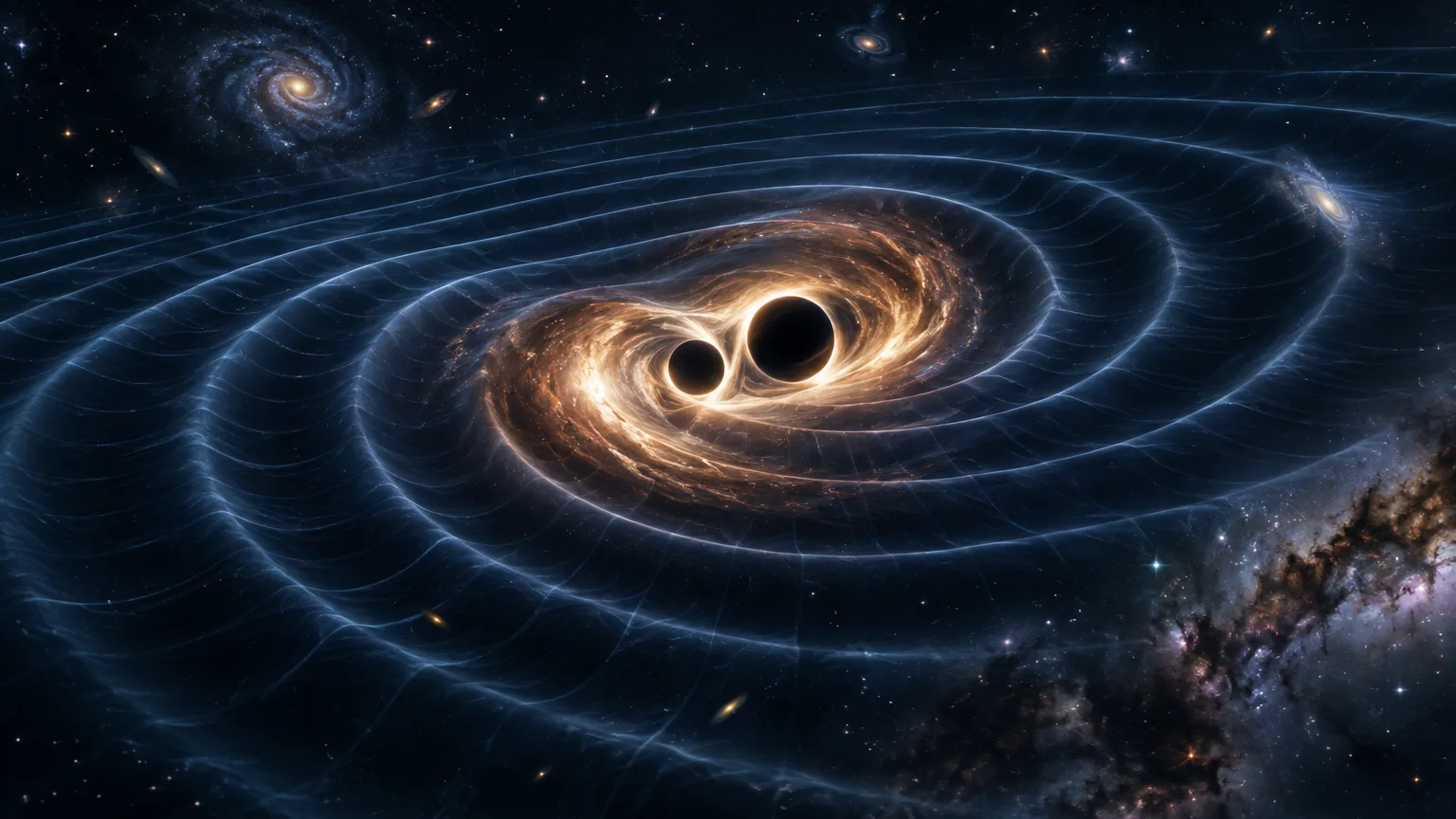
Gravitational waves are disturbances in spacetime. According to research by NASA’s Gravitational Astrophysics Laboratory, general relativity predicts them, and the motion of massive compact objects—including black holes, neutron stars and white dwarfs—can produce them. They are not a form of light or electromagnetic radiation: the European Space Agency (ESA) stresses that they are radically different from electromagnetic radiation, which is associated with accelerating electric charges.
This distinction matters because each signal offers a different observational route. Cosmic light enables the study of sources that emit electromagnetic radiation; gravitational waves instead trace changes associated with extreme motion of mass and gravity. NASA describes them as invisible waves that travel at the speed of light, about 300,000 kilometres per second. Observing them can therefore become a tool for understanding compact objects and the processes involving them.
What these waves indicate
The phrase “gravitational wave” may sound abstract, but it refers to physical fluctuations in spacetime. ESA explains that they promise to open a new window on astronomy by revealing powerful phenomena in the universe that cannot be detected through observations of cosmic light. That promise does not mean they replace optical, infrared or other light-observing telescopes. Their scientific value lies precisely in combining signals of different kinds when the same source can be studied in more than one way.
The sources cited by NASA provide context: black holes, neutron stars and white dwarfs are compact objects. In certain systems, their motion can generate perturbations subsequently sought with specialised detectors. ESO’s material on a neutron-star merger adds a particularly energetic example: when stellar remnants meet, part of their mass can be converted into energy in a violent burst of gravitational waves, within the framework described by Einstein’s equation E=mc².
The visible observation of a source
ESO reported that a collection of its Chile-based telescopes detected and studied the first visible counterpart of a gravitational-wave source. The observation suggests that astronomers were seeing the result of two neutron stars merging. This matters because it links a gravitational signal with observations made through light: it is not only an inference from one measurement, but an investigation of the same source with complementary tools.
ESO’s release also connects that merger with the dispersal of elements such as gold and platinum into space. The supplied evidence supports stating that connection in the context presented by the observatory, but it does not quantify the material produced or establish that all such elements in the universe have one origin. Those refinements should not be added without further data.
Why a space mission
ESA selected LISA, a mission consisting of a trio of satellites to detect gravitational waves from space, as the third L-class mission in its Science Programme. LISA addresses a clear ambition: to build a space observatory dedicated to these signals. According to ESA, observing gravitational waves from space can extend the ability to investigate phenomena not revealed by cosmic light.
LISA’s selection as a mission does not, by itself, mean that scientific results from that observatory already exist. The supplied sources describe its selection and progress towards a space observatory, but this evidence set does not provide a launch date, operations start date, instrument specifications or an expected detection catalogue. Separating observations already reported from projected capabilities is essential to describing the field accurately.
An astronomy of complementary signals
The interest of gravitational waves lies both in what they are and in what they add to the collection of observations. Light-based observations remain essential for locating, characterising and following many astronomical sources. Gravitational waves contribute information from the dynamics of extremely compact objects. Where a visible counterpart exists, as in the ESO case, both approaches can describe different aspects of the same event.
- NASA places their origin in the motion of massive compact objects and notes that general relativity predicted them.
- ESO documents a visible counterpart associated with a gravitational-wave source and interprets it as the result of a merger of two neutron stars.
- ESA is advancing the future component through LISA, the selected three-satellite space detection mission.
What the evidence does not yet establish
The available sources do not provide a complete account of current detections, any LISA results, or enough detail to compare the performance of ground- and space-based detectors. Nor do they allow the events described to be dated beyond information on the linked pages, or establish which specific sources LISA will observe. This overview should therefore be read as an evidence-based explanation of principles, an ESO observational example and an ESA-selected mission—not as an exhaustive account of the newest research.
The conclusion supported by the evidence is narrower, but meaningful: gravitational waves open a route of study distinct from light; they have been connected to a visible counterpart attributed to a neutron-star merger; and Europe is preparing LISA, a space mission intended to broaden this kind of astronomy.
Sources: NASA Goddard, NASA Space Place, ESO, ESA.