

Key facts
- NASA estimates that dark matter accounts for around 27% of the universe and ordinary matter for about 5%.
- Dark matter does not appear to interact with the electromagnetic spectrum, but its gravitational effects make it possible to study its influence.
- In the simulations described by NASA, cold dark matter produces structures more like those observed than warm or hot versions do.
- NASA summarizes that dark matter is more likely to be cold or slow-moving; this conclusion does not identify its particles.
- WIMPs and axions are hypothetical candidates. The source says there is no evidence confirming the candidates it presents.
Related records
Dark matter raises two related but distinct questions: how it influences the structure of the universe and what it is made of. NASA explains that simulations of structure formation favor cold, or slow-moving, dark matter. This preference helps describe how galaxies and other structures fit into cosmic history, but it does not identify the particles responsible.
The distinction matters because “cold” here does not mean a temperature measured with a thermometer. It refers to the speed of the particles in the models. Comparing cold, warm, and hot dark matter makes it possible to study which kind of motion produces structures resembling those astronomers observe.
An invisible matter that leaves gravitational traces
Ordinary matter—the matter that makes up stars, planets, and everyday objects—interacts with light at different wavelengths. Dark matter, according to NASA’s description, does not appear to interact with the electromagnetic spectrum: it does not absorb, reflect, or emit light. However, it has mass and gravitationally affects ordinary matter. So, although it cannot be seen directly, its effects make it possible to study its influence on the cosmos.
The agency estimates that dark matter accounts for around 27% of the universe, compared with about 5% for ordinary matter; the rest is attributed to dark energy. It also notes that dark matter makes up most of the mass of galaxies and galaxy clusters. These proportions are estimates NASA provides as context for explaining the role of the different cosmic components.
One way to trace this mass is to observe how the gravity of large concentrations of matter curves spacetime and bends the light from distant objects. This phenomenon is called gravitational lensing. The observed distortions make it possible to investigate the distribution of mass, including the part that does not emit light.
What the simulations compare
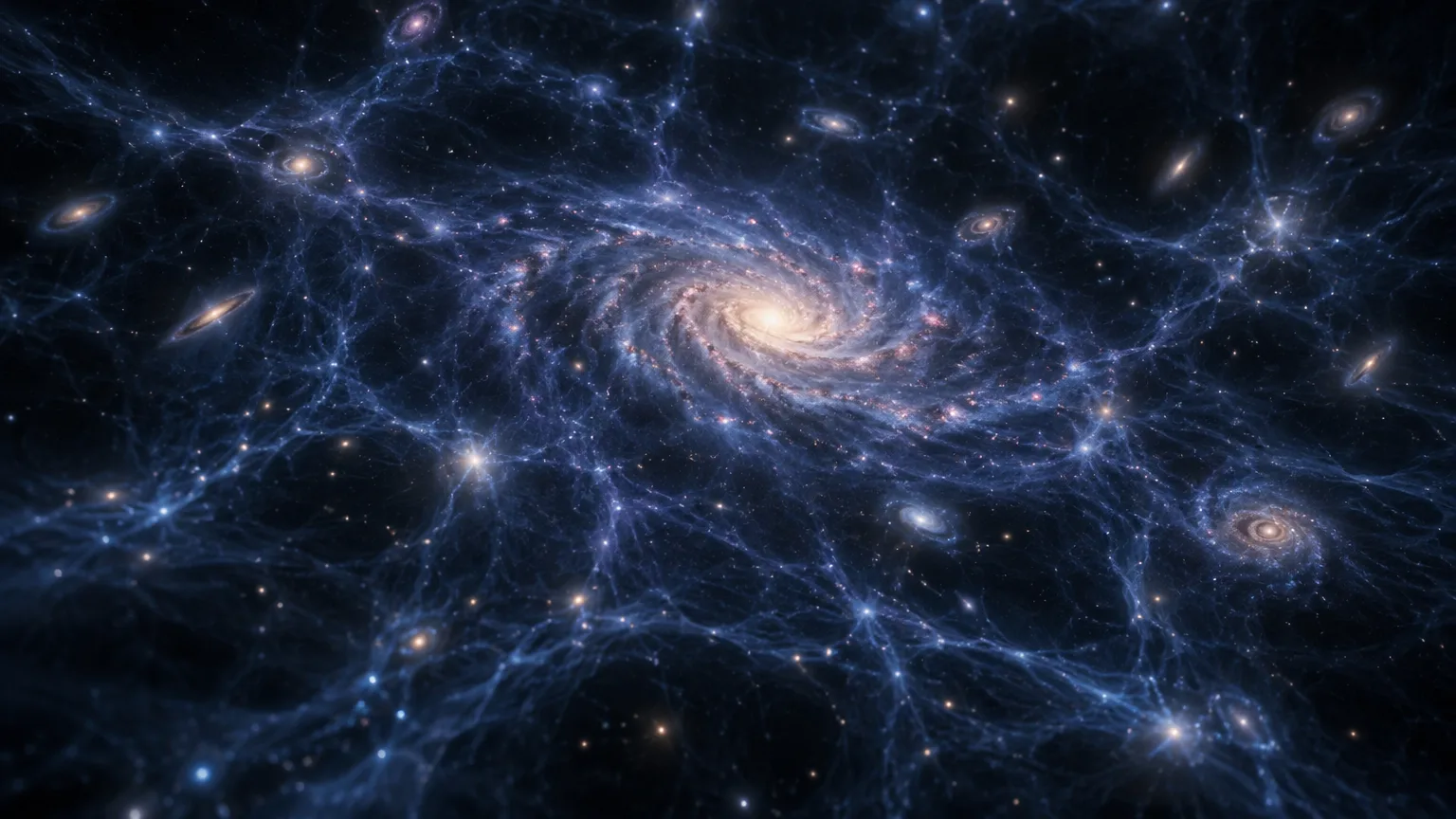
NASA’s explanation describes simulations that test different speeds for dark matter. In models of cold, slow-moving dark matter, structures in the universe appear and move in ways similar to what is observed. By contrast, in simulations with warm or hot dark matter, structures do not appear to remain bound together in the way needed to reproduce those observations.
Based on this comparison, the agency summarizes that scientists consider it more likely that dark matter is cold or moves slowly. It also suggests that dark matter may have formed in the early universe at a sufficiently low speed to allow galaxies to form and spread out as we see them today. This is an inference based on how structures behave in the models: it indicates which kind of motion best fits the observed picture, not the composition of dark matter.
The idea of “cold” should therefore be understood within the context of this comparison. The question is not whether the material is cold in the everyday sense, but whether its particles move slowly enough to clump together and promote the formation of cosmic structures.
From a cosmological description to hypothetical particles
NASA lists several proposals for what might make up dark matter. Among them are WIMPs, an acronym for weakly interacting massive particles. The agency describes them as hypothetical, heavy, slow-moving particles that do not absorb or emit light and do not interact strongly with the particles known so far. They are thought to interact through gravity and perhaps other forces, allowing them to pass through ordinary matter almost unhindered.
Some models suggest that when certain WIMPs meet, they could annihilate one another and produce gamma rays. NASA says that possible signs of this process have been sought in data from the Fermi Gamma-ray Space Telescope. Describing a search, however, is not the same as confirming that WIMPs exist.
Another candidate is the axion, a hypothetical subatomic particle considered to have low mass and low energy. Axions were proposed in 1977 as a possible solution to a particle-physics problem called the strong CP problem. The hypothesis proposes that axions could be dark matter. NASA also notes that data from the Fermi, Chandra, and NuSTAR telescopes have been used to search for signs of axion oscillations in X-ray and gamma-ray observations.
What the simulations allow us to say
The preference for slow-moving dark matter and the search for candidates belong to different levels of research. Simulations compare the effects that different speeds would have on the formation and cohesion of structures. Particle searches, by contrast, aim to find signals associated with specific proposals. A cosmological model’s better fit to observed structures is not enough, by itself, to choose between WIMPs, axions, or other explanations.
NASA itself presents a range of possibilities and notes that dark matter could consist of more than one type of matter or particle. On the page summarizing these candidates, the agency states that no evidence has been found to confirm any of those it describes. The conclusion supported by the available material is therefore limited: simulations favor cold or slow-moving dark matter as an explanation for the observed cosmic structure, while its physical identity remains unknown.
A clue to the history of the cosmos
Understanding how dark matter is distributed may help reconstruct how galaxies formed and evolved. NASA presents simulations as a way to connect the motion of dark matter with the formation of these structures. The preference for slow-moving particles points to a condition that allows matter to clump together in the models; it does not, on its own, resolve the nature of those particles.
The picture is thus divided between a cosmological clue and a microscopic unknown. The former favors cold dark matter because its simulations better match observed structures. The latter—what physical entity produces those gravitational effects—remains open among hypothetical candidates such as WIMPs and axions. Keeping the two questions separate avoids turning an explanation of galaxy formation into an identification that the cited evidence does not provide.