

Key facts
- NASA places Roman’s launch in fall 2026; an August press kit gives August 30 as a target date, not a confirmed launch.
- ESA says Gaia Data Release 4 is expected in December 2026; the available information does not detail its scientific contents.
- CSCSTACK version 2.1.1 reports 493,236 detections and 855,402 entries when photometric upper limits are included.
- ESO describes GRAVITY+ as operational from 2026 and anticipates early, high-precision interferometric results; no specific results are provided in the available information.
- ESO Spain attributes a warning about proposals to launch more than 1.7 million satellites to a new study; its summary does not quantify the effects.
Related records
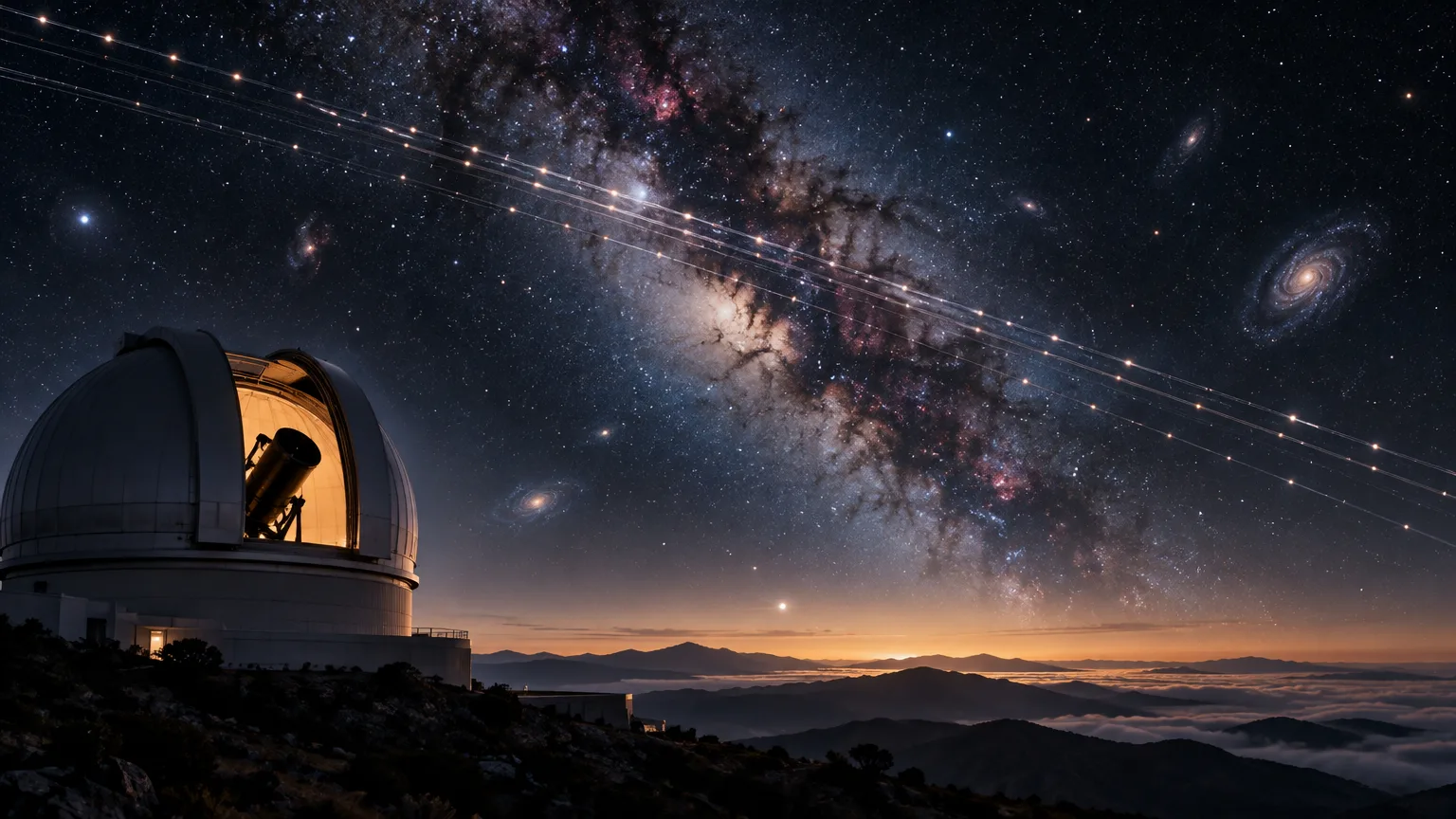
Ongoing astronomy is not limited to newly announced discoveries. It also depends on missions preparing observations, catalogues bringing measurements together, and new facilities extending what telescopes can study. The institutional pages consulted offer examples of these different stages: NASA’s Nancy Grace Roman Space Telescope, the European Space Agency’s (ESA) Gaia mission, NASA’s Chandra X-ray archive, and the European Southern Observatory’s (ESO) GRAVITY+ instrument. The picture also includes a warning about plans to launch large numbers of satellites.
Roman: a mission designed to open a broad window
NASA describes the Nancy Grace Roman Space Telescope as a mission expected to launch in fall 2026. An agency press kit dated August 2026 gives a target launch date of August 30 that year. These are planning statements, not confirmation that the launch has already taken place: a target date can change, while NASA’s Astrophysics page refers to a season rather than a specific day.
The press kit outlines a broad science programme. It says Roman could help study objects in the outer solar system, exploding stars, growing black holes and galaxies by the billions. It also says the data will be made public once processed, allowing multiple teams to analyse them at the same time. This is a description of goals and plans, not a report of scientific results from Roman. The information available here also provides no details about the schedule for its first observations or specific instruments.
Gaia and Chandra: why data releases matter
For Gaia, ESA’s news page says the mission’s fourth data release, known as Gaia Data Release 4 or DR4, is expected in December 2026. The date is linked to an announcement at a Gaia symposium during an astronomical society’s annual meeting in Cork. A data release is a stage in making mission information available for use; the notice at hand does not describe which measurements DR4 will include or support specific predictions about scientific conclusions.
Chandra is NASA’s X-ray observatory. The agency’s HEASARC archive announced version 2.1.1 of CSCSTACK, a table of detections made by stacking observations from the Chandra Source Catalog. The description reports 493,236 detections and 855,402 total entries when detections and photometric upper limits are counted together. An upper limit indicates how faint a source might be without it having been measured as a detection. The available description says the set is based on 10,034, but is truncated before explaining what that number represents; it would therefore be unsafe to assign it a more precise meaning or unit. A catalogue gives researchers more material to consult, but its release is not in itself a new discovery.
GRAVITY+: new ways to study galactic nuclei
An ESO page for the NUCLEI 2026 meeting says GRAVITY+, described as operational from 2026, will deliver early, high-precision interferometric results on both quiescent galactic nuclei and active galactic nuclei (AGN). A galactic nucleus is a galaxy’s central region; an AGN is an especially energetic nucleus. The page adds that the facility will extend stellar-dynamical studies into regimes that were previously inaccessible.
This is prospective language: it describes the opportunities expected from the instrument, not specific observational results. The material consulted does not specify which objects have already been measured or when the first results will be available. In this context, GRAVITY+ should be understood as a new observational capability, not as evidence that a particular question about galaxy centres has been settled.
Satellites and astronomy: a warning, not a complete assessment
An ESO Spain press release dated July 1, 2026, summarises a new study with a stark warning: current proposals to launch more than 1.7 million satellites into orbit, including some that would be extremely bright, would have “devastating consequences for astronomy.” According to the summary, the figure refers to launch proposals, not satellites that are already all in orbit. The excerpt does not give the study’s methods, assumptions or a breakdown of the effects. It therefore does not allow readers to quantify the impact independently or determine which specific proposals were assessed.
Taken together, these updates describe an astronomy infrastructure in development: Roman is preparing a wide-ranging science programme, Gaia and Chandra support access to data sets, and GRAVITY+ promises new observational opportunities. The satellite warning is a reminder that the environment from which astronomers observe matters too. The available evidence identifies plans, announced dates and catalogue counts, but it does not replace the full documents or justify presenting expectations as confirmed results.