

Key facts
- ESA places the beginning of stellar-position measurements thousands of years in the past.
- ESA’s account traces astrometry through the work of observers before the telescope.
- ESA describes Gaia as opening a new era of space-based astrometry.
- The evidence provided does not identify ancient civilizations, exact dates, instruments or specific results of those observations.
- The NASA archive described in the sources preserves material about NASA and its centers; it is not presented as an archive of ancient astronomical observations.
Related records
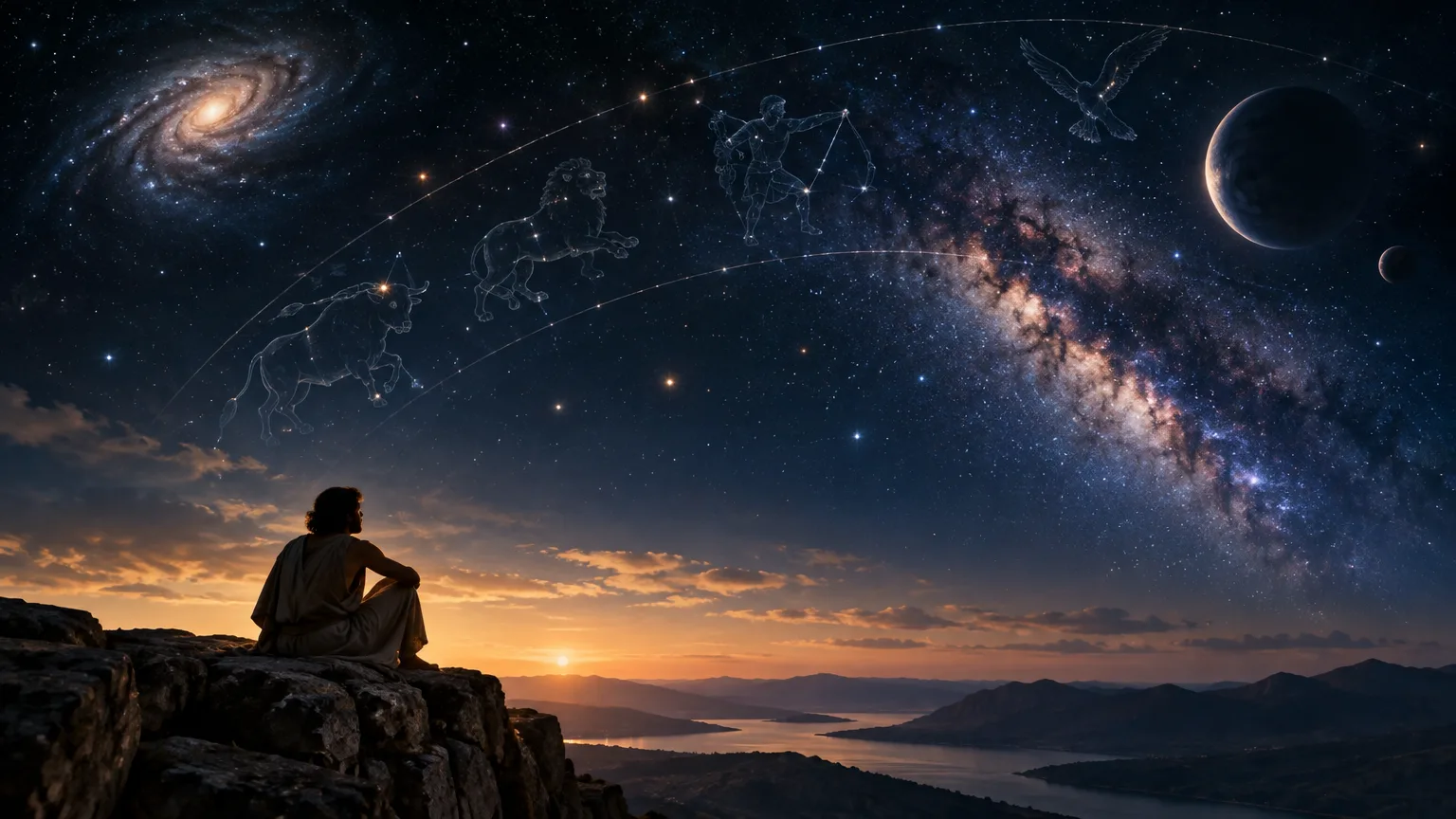
Ancient astronomy often brings to mind stories about constellations, calendars or great monuments. But one concrete way to trace its history is to ask how people learned to measure and record the positions of stars. ESA says these measurements began thousands of years ago and describes their development as a history of observers and scientists who worked before the telescope was invented. This perspective links ancient observations to a discipline that remains active today: astrometry.
What it means to measure the sky
Astrometry studies the positions of celestial objects. Put simply, it does not only involve looking at a star: it seeks to establish where that star appears in the sky and to record its position. ESA’s historical account uses the measurement of stellar positions as its guiding thread, from ancient times through the period before the telescope. Recording positions makes observations comparable. However, the evidence available here does not detail the methods, instruments or units used by each society. It would be inappropriate to fill that gap with examples the sources do not document.
This approach also helps distinguish observation from interpretation. A record of positions describes a measurement task; on its own, the material available does not allow us to attribute a particular theory of the universe to any specific culture. The history of astronomy encompasses many questions and practices, but the evidence provided here relates specifically to measuring stars and to those who did so before the telescope was invented.
A history that predates the telescope
ESA’s timeline is broad: people began measuring stellar positions thousands of years ago, and its account of astrometry traces the period before the telescope. This places ancient astronomy within an ongoing tradition of observation, rather than treating it as an isolated curiosity or a practice that disappeared when modern technology arrived. Still, the cited page, as represented in the available material, does not provide a list of peoples, precise dates, specific observations or instruments. This article therefore does not assign historical priority to a civilization or present particular episodes as facts confirmed by these sources.
The absence of detail does not diminish the central idea: measuring the sky requires careful observation and records that can be described as positions. It also explains why the history of this discipline is presented as a succession of people devoted to the task. ESA characterizes it as a tradition shaped by talented and dedicated observers and scientists, but the available summary does not identify those individuals or allow their biographies to be reconstructed.
What changes with Gaia
Gaia is an ESA mission that the agency links to a new era of astrometry based on observations from space. The point in this historical account is not to attribute results to Gaia that are absent from the evidence provided, but to recognize the change in perspective: stellar positions, measured since long before the telescope, can also be studied with a space mission. ESA’s description therefore places the history of ancient observation in conversation with contemporary research.
Continuity does not mean the techniques are the same. ESA says Gaia opens a new era, but the information available here does not specify its instruments, operating dates, measurement totals or scientific results. It is therefore not possible to make quantitative comparisons between ancient observations and Gaia on the basis of this material. What can be said is that the basic question—where stars appear—remains central to a discipline whose tools and scale have changed.
How to read the historical evidence
Institutional archives can help preserve and provide access to documents, but not every archive supports every kind of historical claim. NASA says its archives preserve primary-source material relating to NASA’s own history and its centers. As described, that institutional collection is not equivalent to a repository of ancient astronomy records. ESA, in turn, offers a historical overview of astrometry before the telescope. Distinguishing these purposes helps prevent a contextual guide from being mistaken for an original record of an ancient observation.
The conclusion should remain proportionate to the sources: measuring stellar positions has a history stretching back thousands of years, and ESA presents Gaia as a new space-based phase of astrometry. The evidence provided here is not sufficient to date the earliest records, identify their authors or reconstruct their methods in detail. Those questions remain open within the limits of the sources consulted and would require more specific historical evidence.
A continuity, not a straight line
The history of ancient astronomy can cautiously be told as a long practice of observation and measurement that predates the telescope and reaches the present through new tools. This account does not require us to imagine that every culture observed in the same way, or that each stage inevitably led to the next. The available evidence supports a broad continuity in the task of measuring stellar positions; it does not establish a detailed chronology or explain every transformation.
The connection to Gaia offers a useful perspective: space technology does not replace the ancient question of where the stars are, but takes it into a new observational setting. To understand more, we would need sources identifying particular records, communities and methods. Until then, the strongest claim is also the simplest: people were measuring the sky long before the telescope.