

Key facts
- Littenberg and Cornish submitted their study to arXiv on 2 August 2019; version 2, dated 5 August, states that it was accepted in Astrophysical Journal Letters.
- ZTFJ1539+5027 is an eclipsing binary of two white dwarfs with a 6.91-minute orbital period; the LISA analysis used simulated signals.
- For about four years of simulated data, the study calculated a signal-to-noise ratio close to 140.
- The projected uncertainty in inclination is about 1° after one year and 0.15° after eight simulated years.
- In the extended scenario, distance precision could improve by a factor of 10, under the study’s assumptions.
- The paper expresses its projected constraint on the speed of gravity as 3.2 (2.1) × 10^-12 of the speed of light; this is not a measurement.
Related records
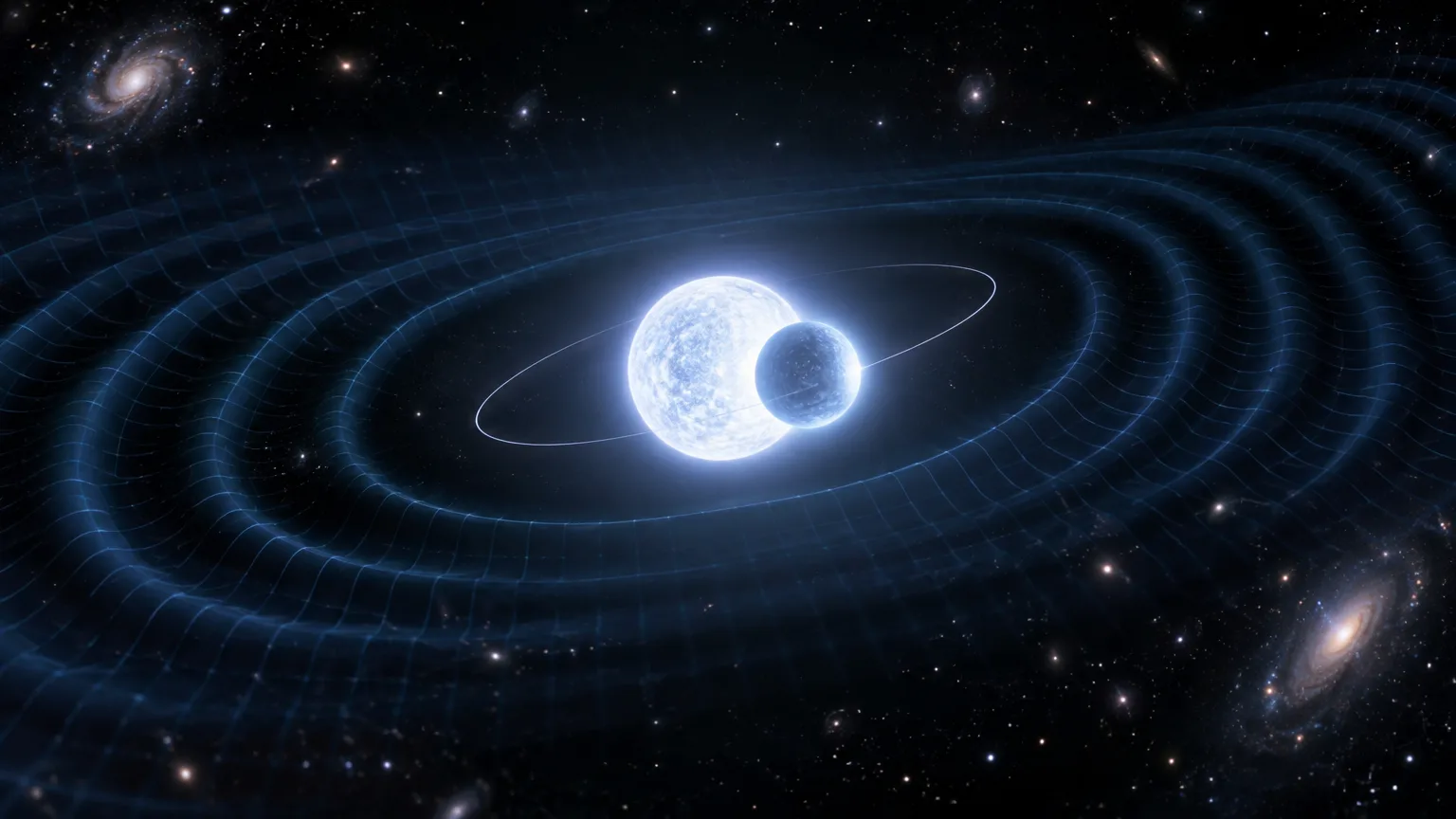
Gravitational waves offer a way to study cosmic phenomena that is distinct from light. The planned mission LISA—the Laser Interferometer Space Antenna—will be a space-based detector with peak sensitivity in the frequency range occupied by short-period compact binaries. ZTFJ1539+5027 belongs to this class and was already known from electromagnetic observations. Littenberg and Cornish asked what additional information LISA might provide once operational: their figures are forecasts based on simulations, not observational results.
The authors submitted their work to arXiv on 2 August 2019 and posted version 2 on 5 August. That version states that the paper was accepted in Astrophysical Journal Letters. The full text describes the method and projections in its arXiv version 2. As context, a separate discovery paper reported ZTFJ1539+5027 as an eclipsing binary of two white dwarfs, with an orbital period of 6.91 minutes and rapid orbital decay consistent with general relativity (discovery paper).
How the simulations were built
The analysis began with system parameters measured through electromagnetic observations and used them to generate a reference gravitational-wave signal. Those measurements did not determine some signal characteristics: its polarization and initial phase. The researchers assigned random values to these parameters from uniform distributions. They then applied an analysis method designed to detect and characterize compact binaries in simulated LISA data.
The team considered hypothetical observing periods of one, two, four and eight years. In the paper, four years serve as a nominal reference duration and eight years represent a possible extended-mission scenario. These are not periods already observed by LISA. The search was also targeted: the sky position of ZTFJ1539 was fixed in advance, and the analysis focused on the narrow frequency band containing its signal. These conditions define the scope of the projections.
A prominent signal in the model
For about four years of simulated data, the authors obtained a signal-to-noise ratio of approximately 140. When they randomized the polarization and initial phase, about 20% of simulations allowed detection within a week when searching specifically at the source’s sky position. The rapid-detection result depended on the values of those two parameters.
In the simulations, the source would be unambiguously detectable after roughly one month, regardless of those initial conditions. The study also examined the possible presence of other binaries in the analyzed band using simulations of galactic populations. For the nominal duration considered, the authors concluded that the chance of ZTFJ1539 being blended with another source or misidentified was low. This is a conclusion within the modeled scenario, not a guarantee about future data.
Projected improvements in inclination and distance
Inclination describes the orientation of the orbit relative to the observer. According to the simulations, LISA could measure it with a one-standard-deviation uncertainty of about 1° after one year and 0.15° after eight years in the extended scenario. The paper compares that latter precision with the electromagnetic measurement available to the study and estimates it to be about five times better.
Distance could also benefit from combining electromagnetic and gravitational information. After two simulated years, the projected precision would be comparable to that provided by electromagnetic observations at the time; with an extended mission, the measurement could improve by a factor of 10. The authors add that improvement could arrive after about a year if continued electromagnetic monitoring enabled a better measurement of orbital evolution. This estimate assumes that the evolution is dominated by gravitational-wave emission, as predicted by general relativity, and accounts for uncertainty in tidal dissipation.
Combining observations would bring together different kinds of information: gravitational-wave analysis could directly measure distance and inclination and independently constrain orbital dynamics. In the model, orbital changes associated with gravitational-wave emission could also help separate parameters that would otherwise be difficult to distinguish. This is a possibility raised by the study, not a result already observed for this source.
The speed of gravity and the limits of the forecast
The researchers also examined how to compare electromagnetic eclipse timings with the initial phase of the gravitational-wave signal. In the simulations, LISA could determine those timings to a precision of less than one second. From that comparison, the paper proposes a novel constraint: the speed of gravity would be within 3.2 (2.1) × 10−12 of the speed of light. That is the notation given in the paper; it is not a measurement made for ZTFJ1539. The authors say the constraint would be about 1,000 times weaker than the one obtained from joint gravitational-wave and electromagnetic observations of GW170817, although it concerns very different frequencies and environments.
The figures depend on the initial electromagnetic parameters, signal model, simulated observing time and analysis assumptions. For the remaining free gravitational-wave parameters, the authors used uniform prior distributions. They also considered possible additional sources in the band, although their main analysis focused on the target signal. The paper therefore presents a prospective assessment conditioned on these choices, not a description of an actual observation.
In summary: the 2019 study shows how ZTFJ1539+5027 could help combine electromagnetic observations with gravitational-wave data. Its simulations forecast a detectable source and possible improvements in inclination and distance, as well as a constraint on the speed of gravity. The essential distinction is that these are projections for LISA, not detections or tests already conducted with this binary.