

Key facts
- The simulation combines PlanetaLP and radmc-3D.
- The model disk contains a 1 M_Jup planet at 57 au.
- The simulated sequence extends to approximately 1 Myr and compares its morphologies with five observed disks.
- The authors say the result supports a planetary origin for the substructures and makes it possible to identify planets beyond the reach of more direct techniques.
- The paper was published on May 6, 2025, in The Astrophysical Journal Letters, 984(2), L57.
Related records
The study is part of the work of ODISEA, an acronym for Ophiuchus DIsk Survey Employing ALMA. An earlier proposal developed as part of that survey outlined an evolutionary sequence to unify the diversity of substructures observed in protoplanetary disks. The current paper reproduces key aspects of that sequence through simulations.
A simulated disk and its changes
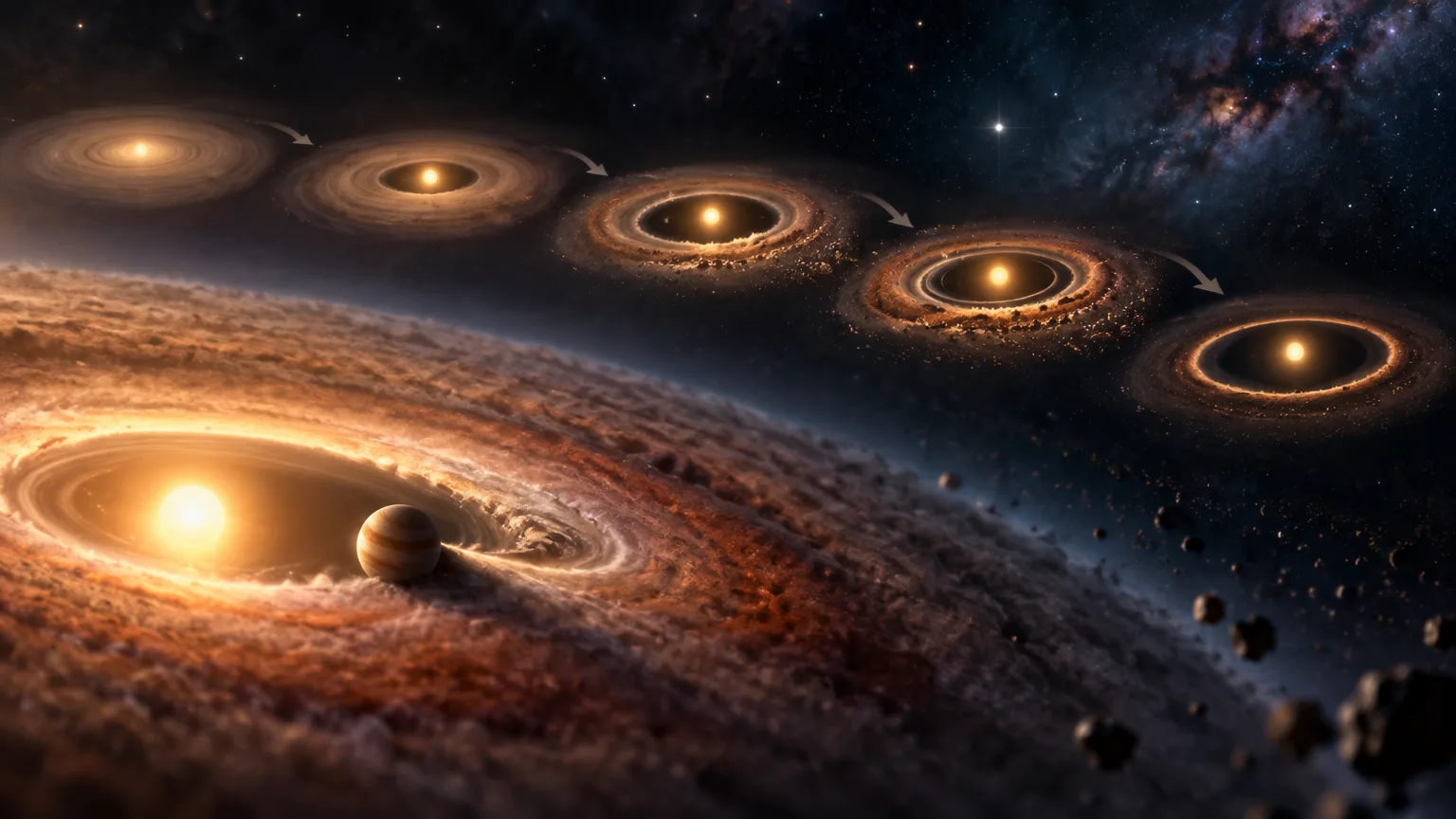
The authors combined PlanetaLP, a disk evolution and planet formation code, with radmc-3D, a radiative transfer code. They modeled an initially smooth disk resembling WLY 2-63, with a planet of 1 MJup located 57 au from the central star.
- After a few hundred orbits, a narrow gap appears, comparable to the morphology of ISO-Oph 17.
- By 0.1 Myr, the gap widens and dust accumulates at the cavity edge, as in Elias 2-24.
- Around 0.4 Myr, the disk takes on a morphology similar to DoAr 44, with a smaller inner disk and a brighter inner edge.
- By 1 Myr, the system transitions to a single narrow ring, comparable to the one observed in RXJ1633.9–2442.
The similarities to WLY 2-63, ISO-Oph 17, Elias 2-24, DoAr 44, and RXJ1633.9–2442 describe comparisons between the simulated forms and those observed in these disks; the sequence presented corresponds to the model studied.
What the result implies
The authors note that this line of work strongly supports a planetary origin for disk substructures. It also makes it possible to identify a population of planets that currently lies beyond the reach of more direct detection techniques. The source presents this identification as a possibility.
The open-access paper appeared in The Astrophysical Journal Letters, volume 984, issue 2, as L57. The journal records its receipt on February 22, 2025, revision on March 21, acceptance on March 29, and publication on May 6, 2025. Read the paper.