

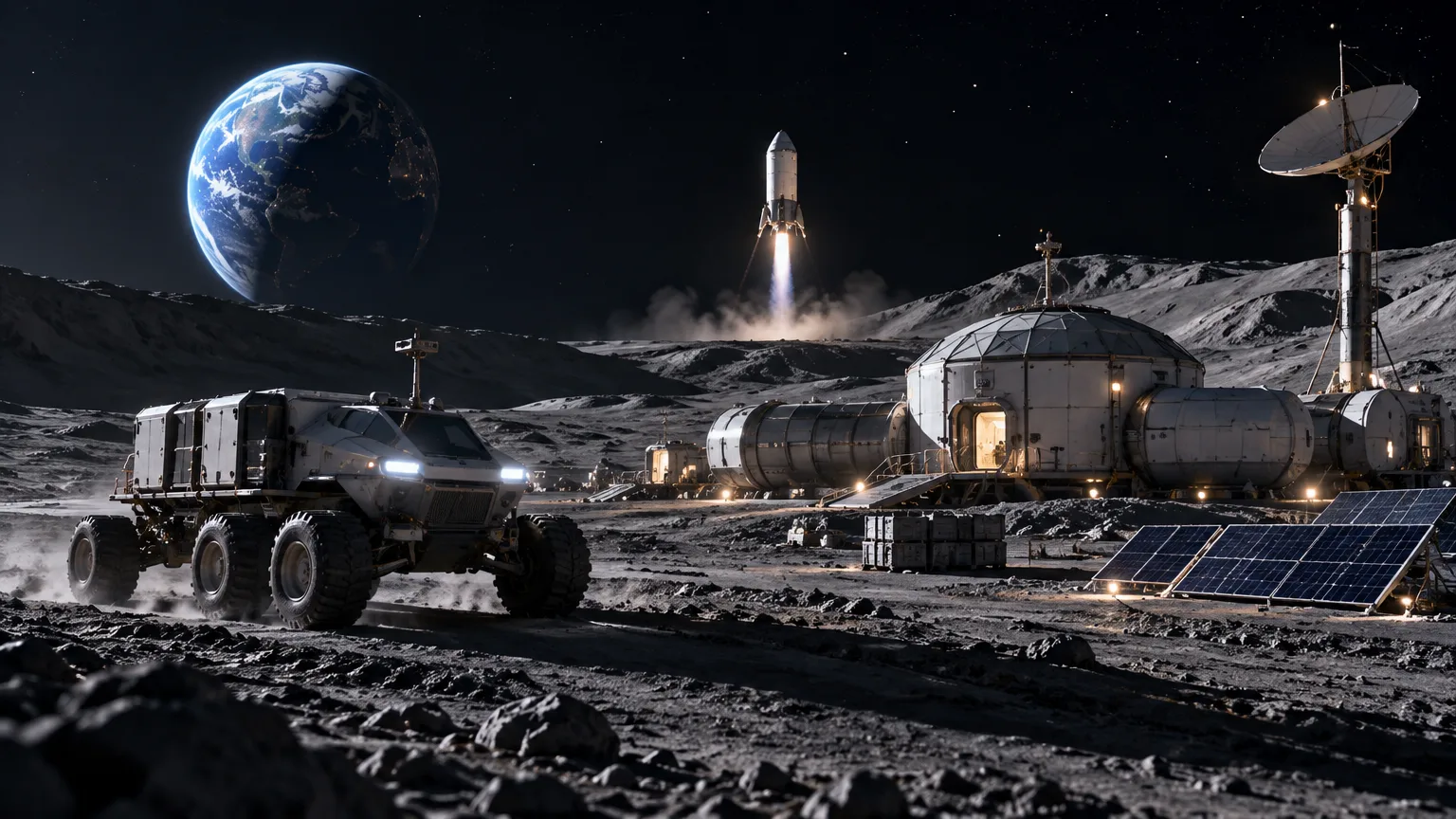
Key facts
- NASA's announcement was published on November 7, 2026, and gathers awards and updates for the Moon Base program.
- Eight companies will be able to compete for future lunar deliveries under the CLPS 2 contract, which is ten years long and has a combined maximum of $10 billion.
- NASA raised the value of CLPS 1.0 from $2.6 billion to $4.2 billion; the original contract will remain in effect until November 2028, and awarded deliveries can be completed until November 2033.
- PROMISE will be a six-wheeled nuclear rover to study the lunar south pole; NASA aims to launch it in late 2028 and plans an 18-month mission.
- Blue Origin received $94 million as a base contract to deliver PROMISE, with an additional option of $140 million subject to performance.
- NASA awarded six VADR task orders; the awards to Arrow Science and Technology, Blue Origin, and Impulse Space have a combined value of approximately $1.3 billion. The framework maximum is $5 billion.
- SpaceX will launch communications satellites aboard a Starship to cislunar space in 2028 for a demonstration selected by NASA.
- NASA awarded components for miniCAST: energy storage to Honeybee Robotics, power generation to Redwire, and wireless power transfer to Yank Technologies.
Related records
NASA announced a series of awards and mission updates on November 7, 2026, to expand the exploration, science, and infrastructure capabilities of Moon Base, its program to establish a sustained presence at the lunar south pole. The agency presented the measures at the MAX POWER aerospace expo and air show, held at the Kennedy Space Center in Florida.
The package combines commercial services to deliver cargo to the surface, transport between Earth and the Moon, the development of a nuclear-powered rover, and components to supply power and communications for future lunar operations. NASA aims to advance through successive missions and technologies that can support the arrival of astronauts and subsequent activities.
Eight companies to compete for future lunar deliveries
In the next phase of CLPS (Commercial Lunar Payload Services), NASA selected Blue Origin, Firefly Aerospace, Intuitive Machines, ispace-U.S., Lockheed Martin Space, Northrop Grumman Space Systems, SpaceX, and Voyager Technologies. The eight companies will be able to compete for future missions under CLPS 2, which contemplates lunar delivery services: the companies will manage, build, and operate landing modules to transport scientific instruments, technology, and infrastructure.
CLPS 2 is a ten-year framework contract with multiple awardees and indefinite quantity and delivery orders. Its combined maximum value is $10 billion. NASA also raised the value of the existing CLPS 1.0 contract from $2.6 billion to $4.2 billion to support the initial goals of the first phase of Moon Base. CLPS 1.0 will remain in effect until November 2028; an additional five-year period will allow the completion of already awarded lunar deliveries until November 2033.
PROMISE: a nuclear rover for the south pole
The agency will proceed with PROMISE (Polar Rover for Observation, Mapping, and In-Situ Exploration), a six-wheeled vehicle that will run on nuclear power. Its mission will be to study the surface and subsurface of the lunar south pole, assess resources, and provide information to select landing sites and plan future exploration and infrastructure activities.
The rover will be able to operate during the long lunar nights and in permanently shadowed regions, where ice is believed to exist. It will carry a drill to extract regolith—the loose surface material of the Moon—to a depth of about 3 feet (1 meter); spectrometers to analyze chemical composition; temperature and radiation sensors; and visible light cameras. It will also test a radiation-resistant computer system and advanced autonomy sensors and algorithms.
NASA's Jet Propulsion Laboratory, in Southern California and managed by Caltech, will lead the mission and build the rover using a combination of spare flight components and engineering test models from the Mars rovers Curiosity and Perseverance. NASA states that reusing hardware, software, and operational methods already proven on Mars reduces costs and shortens the integration and testing schedule; it also indicates that it has evaluated the compatibility of these components with the lunar environment.
The agency aims to launch PROMISE in late 2028 and plans an 18-month mission. Blue Origin received a base contract of $94 million to deliver the rover to the lunar south pole, with an option for an additional $140 million subject to performance. The award expands a work order granted to the company in May 2026 to deliver two lunar terrain vehicles. Blue Origin will use its Mark 1 landing module to transport and deploy PROMISE as part of the first phase of Moon Base.
Transport and communications between Earth and the Moon
To move cargo to the Moon, NASA combines launchers, orbital transfer vehicles, and landing modules. Orbital transfer vehicles (OTVs) transport cargo through space; the modules perform the final leg to the surface.
NASA awarded six task orders under the VADR (Venture-Class Acquisition of Dedicated and Rideshare) launch services contract. Arrow Science and Technology, Blue Origin, and Impulse Space received awards to integrate and transport Moon Base cargo. The awards to these companies have a combined value of approximately $1.3 billion. The ten-year VADR framework has a maximum total value of $5 billion across all contracts.
The planned missions cover three types of demonstrations: communications, navigation, and orbital transfer tests for future human flights; mobile drones to explore the south pole before the arrival of astronauts; and navigation and operations tests in various cislunar orbits, that is, in the space between Earth and the Moon. Among the cited initiatives are the delivery of the CAPSTONE 02 spacecraft to test proximity maneuvers, navigation, and communications around the Moon, and the MoonFall drones, designed to explore areas beyond the reach of traditional rovers. NASA indicated that some missions will fly on New Glenn rockets by Blue Origin; Terran R by Relativity Space; and Falcon 9 by SpaceX. Space transport vehicles will be provided by Blue Origin, Firefly Aerospace, Impulse Space, and Quantum Space.
Separately, SpaceX was selected for the cislunar communications deployment demonstration, through a work order of an existing lunar logistics contract. The company will launch communications satellites aboard a Starship to cislunar space in 2028. The test will serve to guide the development of future communication networks connecting astronauts, mission control teams, and Moon Base.
Components for power and communications on the surface
NASA plans to acquire commercial components for a miniCAST tower for communications and solar power. The set will include solar panels, batteries, and wireless power transfer technology. Honeybee Robotics, a Blue Origin company, received an award for energy storage; Redwire, for power generation; and Yank Technologies, for wireless transfer.
The goal is to combine power and communications to support future activities on the Moon. Engineers from NASA's Marshall Space Flight Center in Huntsville, Alabama, will assemble and test the systems before their delivery to the surface. Initial work will focus on components, not a complete integrated system; the agency plans to separately publish a solicitation for integrated power systems, expected in early 2027.
NASA also plans to issue a directed solicitation within NextSTEP-3 B, its partnership program for exploration technologies, to obtain priority data for the development of Moon Base. The work could include small spacecraft missions, payloads on future program flights, or the purchase of data gathered by commercial partners.