

Key facts
- SN 1987A was first observed in February 1987 and is about 160,000 light-years away, in the Large Magellanic Cloud.
- Webb observed ionized argon in the expelled material; later observations with NIRSpec detected argon missing five of its 18 electrons.
- The observed ions require high-energy photons; the team concludes that a source of this radiation must be present at the center of the remnant.
- The researchers consider a newly born neutron star the most likely explanation for the emission.
- The main observations were made on July 16, 2022, using MIRI's medium-resolution mode; NASA's announcement was published on February 22, 2024.
- The study was published in the journal Science.
Related records
The NASA announcement, published on February 22, 2024, presents James Webb Space Telescope observations that provide the strongest evidence yet of emission from a newly formed compact object at the site of supernova SN 1987A. The supernova occurred about 160,000 light-years away, in the Large Magellanic Cloud, and was first observed from Earth in February 1987.
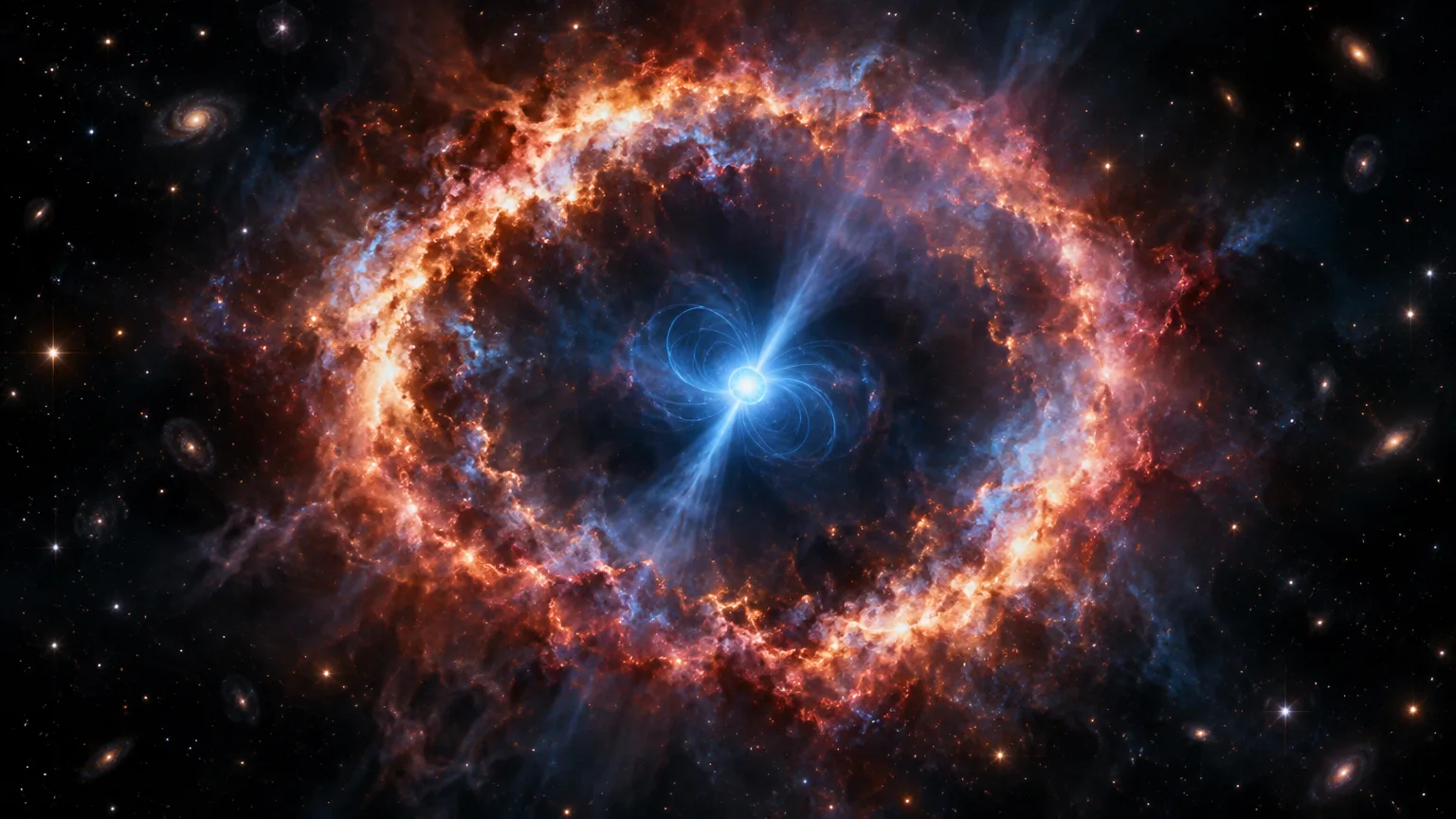
SN 1987A was a core-collapse supernova: according to the team's explanation, this type of explosion leaves a compact object at its center, either a neutron star or a black hole. Astronomers had been searching for signs of that object in the expanding material left behind after the explosion. The work reported by NASA describes signs of high-energy radiation associated with the center of the remnant, which the researchers consider likely to be produced by a young neutron star.
Ionized argon in the expelled material
The observations underlying the result were taken on July 16, 2022, among Webb's first observations to study this remnant. The team used the medium-resolution spectroscopic mode of the MIRI instrument, which observes in the mid-infrared. A spectrograph separates light into its wavelengths; the mode used can obtain a spectrum for each pixel and examine how emission varies across the object.
The analysis detected a strong signal from ionized argon at the center of the expelled material surrounding the explosion site. Later observations with NIRSpec, Webb's near-infrared spectrograph, found even more highly ionized elements, particularly argon missing five of its 18 electrons. Producing these ions requires very energetic photons. Based on this requirement, the team concludes that a high-energy radiation source must exist at the center of the remnant.
Why the evidence points to a neutron star
About two hours before SN 1987A's first observation in visible light, three observatories detected a neutrino burst lasting a few seconds. That signal and the supernova were linked to the same event and provided important evidence for the core-collapse theory, which predicts the formation of a neutron star or a black hole. In recent years, indirect signs of a neutron star in the remnant had also been found, but the announcement describes the new observations as the first detection of the effects of high-energy emission from the probable young object.
The team examined different explanations for the radiation capable of ionizing argon and says that only a few appear plausible; all of them involve a newly born neutron star. The finding therefore supports that interpretation, but the object is identified as probable. The NASA report also conveys the team's expectation that further observations will make it possible to better understand what exactly is happening at the center of SN 1987A.
A remnant observed as it evolves
SN 1987A is among the closest and youngest identified recent supernovae, and its remains continue to change rapidly. The explosion was observed in February 1987, and its brightness peaked in May of that year. This evolution over decades gives astronomers an opportunity to study aspects of a stellar explosion and its remnant in real time.
The announcement explains that the results were published in the journal Science. Webb is an international mission led by NASA in partnership with the European Space Agency (ESA) and the Canadian Space Agency. In the study, MIRI provided the infrared observations of argon, while NIRSpec provided the later observations at shorter wavelengths.
The main conclusion is that the center of the remnant contains a radiation source capable of producing the observed ions. According to the models considered by the researchers, a newly born neutron star is the most likely explanation; the team expects follow-up observations to help determine the nature of the emission more precisely.