

Key facts
- NASA published information about the MATRIX team on October 26, 2026; the work was conducted during that summer.
- MPG estimates fuel mass using the tanks’ acoustic response and is scheduled to be demonstrated on IM-3.
- The analysis identified potential measurement windows during lunar orbit insertion and powered descent, and in some cases during descent orbit insertion.
- The spacecraft’s initial mass had the greatest influence on the duration of each measurement window.
- NASA said the Trinity lander is scheduled to land in the lunar region of Reiner Gamma in 2027.
Related records
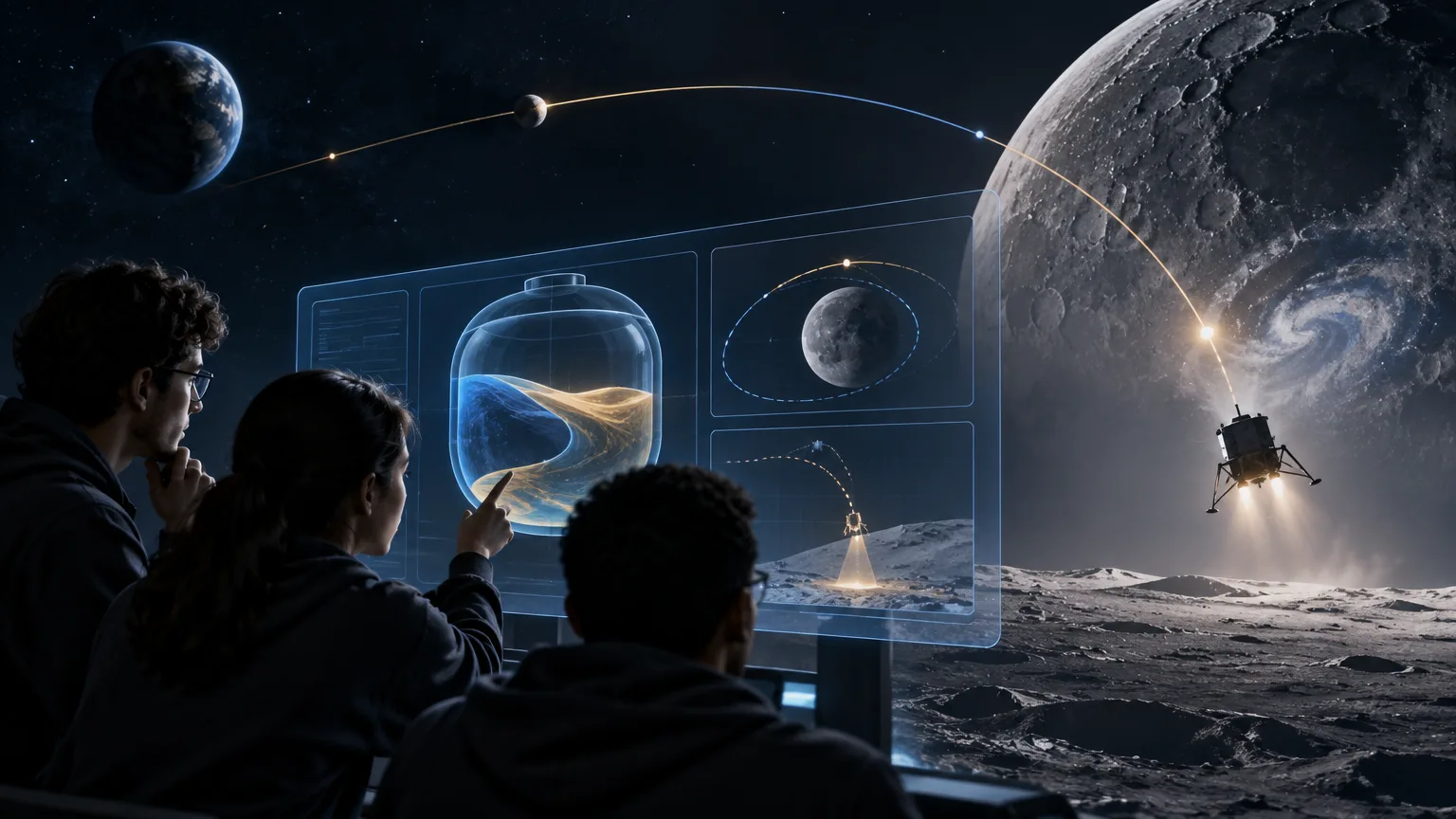
On October 26, 2026, NASA reported that the MATRIX team in the STEM Enhancement in Earth Science (SEES) program developed models to predict when the propellant modal gauging technique, or MPG, could take reliable readings during Intuitive Machines’ IM-3 lunar mission. The team worked during the summer of 2026 and was mentored by Dr. Kevin Crosby of Carthage College.
Measuring propellant through its acoustic response
MPG estimates the mass of fuel inside a tank from its acoustic response. Crosby developed the method at Carthage College with NASA colleagues. According to the agency, it has been used successfully in several space experiments and is scheduled for a demonstration on IM-3.
The project addressed measuring propellant mass in microgravity, where liquid fuel clings to tank walls—a challenge identified as central to Artemis missions. SEES, hosted by the University of Texas Center for Space Research, organizes small teams of high school students who work on mission-focused projects and receive guidance from specialists at NASA, universities, and industry. MATRIX stands for Mission Architecture Tool for Research, Integration, and eXploration.
Reconstruction from public data
The team used public sources, including mission data released by Intuitive Machines and detailed trajectory records for IM-1 and IM-2 provided by NASA’s Jet Propulsion Laboratory Navigation and Ancillary Information Facility (NAIF). To analyze IM-2, it compared the reconstructed spacecraft trajectory with a model of its motion without engine thrust. This allowed it to identify engine burns and estimate the velocity change associated with each one.
The team developed an algorithm to reconstruct IM-3’s trajectory using published data from IM-1 and IM-2. It also ran computational fluid dynamics (CFD) simulations to estimate how liquid moves inside the tanks, and Monte Carlo simulations to predict the range of possible propellant states.
Potential measurement windows
The analysis indicated that MPG could take reliable readings during the two main maneuvers: lunar orbit insertion (LOI) and powered descent. In some cases, it might also do so during descent orbit insertion. The spacecraft’s initial mass had the greatest influence on the duration of each measurement window.
MATRIX also identified candidate IM-3 launch opportunities for 2027 and prepared a landing analysis for Reiner Gamma showing the distribution of possible landing sites near the target. NASA said the IM-3 lander, named Trinity, is scheduled to touch down on the lunar surface in that region in 2027.
Project presentations
The students explained their methods and results to Intuitive Machines’ propulsion group. They also presented the research at the annual SEES symposium and the Wisconsin Space Grant Consortium’s annual conference. In its published information, NASA said the team planned to present it again at the American Geophysical Union’s (AGU) annual meeting in San Francisco in December 2026.
The work brought together publicly available trajectories and models to estimate when MPG measurements might be feasible during the mission. The technique’s demonstration and Trinity’s landing at Reiner Gamma are listed as activities scheduled for IM-3 in 2027.