

Key facts
- ESA published Euclid’s first survey data release on March 19, 2025, with previews of three deep fields.
- In one week and with one scan of each region, Euclid detected 26 million galaxies; the most distant are up to 10.5 billion light-years away.
- The release includes a catalog of more than 380,000 classified galaxies and 500 strong galaxy–galaxy gravitational lens candidates.
- Zoobot was trained using Euclid image classifications made by 9,976 Galaxy Zoo volunteers during a one-month campaign.
- ESA anticipates about 7,000 strong lens candidates for the late-2026 cosmology release and on the order of 100,000 by the end of the mission.
- As of March 19, 2025, Euclid had observed about 2,000 square degrees, approximately 14% of the 14,000 square degrees planned for the survey.
Related records
Euclid is a European mission built and operated by ESA, with contributions from its Member States and NASA. Its high-resolution visible imager, VIS, measures galaxy shapes and distributions; the near-infrared-sensitive NISP instrument is essential for studying their distances and masses. ESA explains that these data will help investigate the large-scale structure of the cosmic web and, through gravitational lensing, the distribution of dark matter. The mission’s full potential for studying dark matter and dark energy through this structure will be reached when the survey is complete.
Three deep fields, an initial observation
In one week of observations, with one scan of each region, Euclid detected 26 million galaxies across the three deep fields. The most distant are up to 10.5 billion light-years away. The first published view covers 63.1 square degrees. ESA notes that over the next few years, Euclid will observe each field between 30 and 52 times during its six-year mission, improving the images and increasing the number of objects observed. At the mission’s planned end in 2030, the high-quality atlas will cover one-third of the sky, about 14,000 square degrees.
The images also show galaxy clusters, active galactic nuclei, and transient phenomena. ESA reports that, as of March 19, 2025, Euclid had observed about 2,000 square degrees, approximately 14% of the survey’s total area. Quick releases such as this one present data from selected areas to show the products expected from the main releases and help scientists prepare their analysis tools.
A catalog classified with help from volunteers and Zoobot
The first release includes a detailed catalog of more than 380,000 galaxies, classified by features such as spiral arms, central bars, and tidal tails that indicate mergers. The catalog was created with Zoobot, an artificial intelligence algorithm. During a one-month campaign on Galaxy Zoo, 9,976 volunteers classified Euclid images and helped train the algorithm to recognize galactic features.
According to ESA, the catalog represents 0.4% of the total number of galaxies at similar resolution expected to be imaged during the mission. The agency says the final catalog will provide detailed morphology for at least an order of magnitude more galaxies than have been measured so far.
500 strong gravitational lens candidates
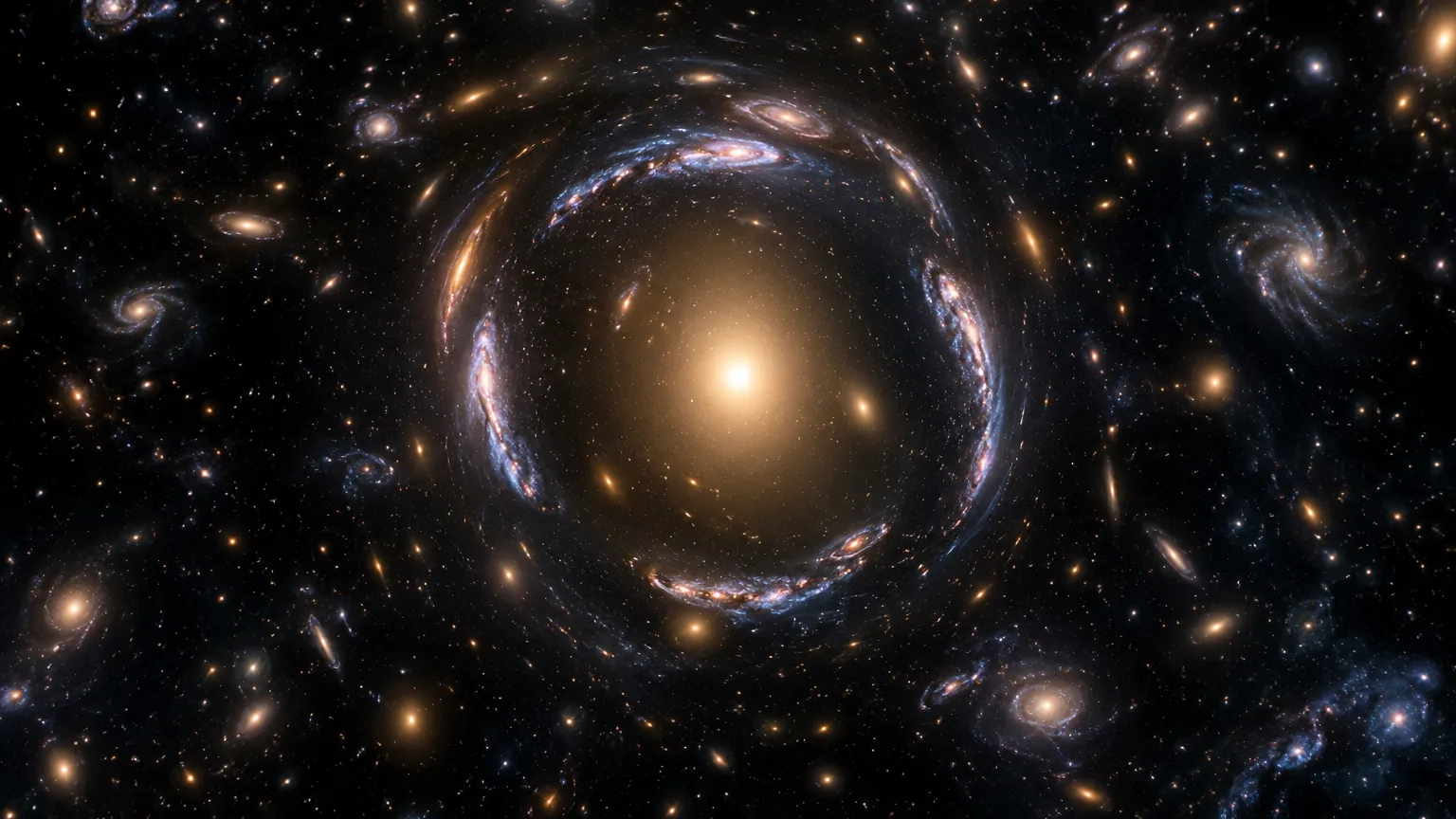
Light from distant galaxies can be deflected and distorted as it passes through foreground ordinary matter and dark matter. ESA describes this effect as gravitational lensing. When the distortions are highly visible, it is called strong lensing: arcs, Einstein rings, or multiple images of a background galaxy may appear.
The published release contains 500 strong galaxy–galaxy lens candidates, almost all of which ESA describes as previously unknown. They were selected by combining an initial screening with artificial intelligence models, inspection by citizen science volunteers, expert assessment, and modeling. In these systems, a foreground galaxy and its dark matter halo act as a lens and distort the image of a background galaxy.
ESA anticipates about 7,000 candidates in the major cosmology data release planned for late 2026 and on the order of 100,000 strong galaxy–galaxy lenses by the end of the mission. Euclid will also measure weak lensing: much smaller distortions that, according to the agency, can only be detected by statistically analyzing large numbers of galaxies. ESA says that over the coming years, the mission will measure the distorted shapes of billions of galaxies across 10 billion years of cosmic history, providing a three-dimensional view of the distribution of dark matter.
What was published and what remains for future releases
ESA describes the March 19, 2025 publication as a selection of areas intended to demonstrate the data products and prepare analyses for the main releases. Euclid’s first cosmology data release to the community is scheduled for October 2026; it will include data accumulated through additional passes over the deep fields.
ESA reports that the scientific papers describing this release had not yet undergone peer review and would be submitted to the journal Astronomy & Astrophysics. ESA also said that preprints were available. This distinguishes the agency’s announcement and the data products presented from the associated scientific papers, whose editorial status should be described according to that information.
Euclid launched in July 2023 and began routine science observations on February 14, 2024. The Euclid Consortium, made up of more than 2,000 scientists from 300 institutions in 15 European countries, the United States, Canada, and Japan, provides the scientific instruments and carries out data analysis. NASA supplied the detectors for the NISP near-infrared spectrometer and photometer.