

Key facts
- The Soviet Luna program operated from 1958 to 1976 and achieved robotic lunar landings, rover traverses, and automated sample returns.
- Ulkar Karimova, Yu Yi, and Kyungguk Min’s review was published online on September 30, 2026, in the Journal of Astronomy and Space Sciences.
- The review summarizes regolith grain size increasing from 70 to 130 μm and density rising from 0.8 to 1.2 g/cm^3 with depth.
- The article reports geochemical gradients between maria and highlands and localized magnetic anomalies of 20–30 nT described as impact-generated.
- The review finds broad agreement between Luna and Apollo data, with differences attributed to landing-site geology and instrument characteristics.
Related records
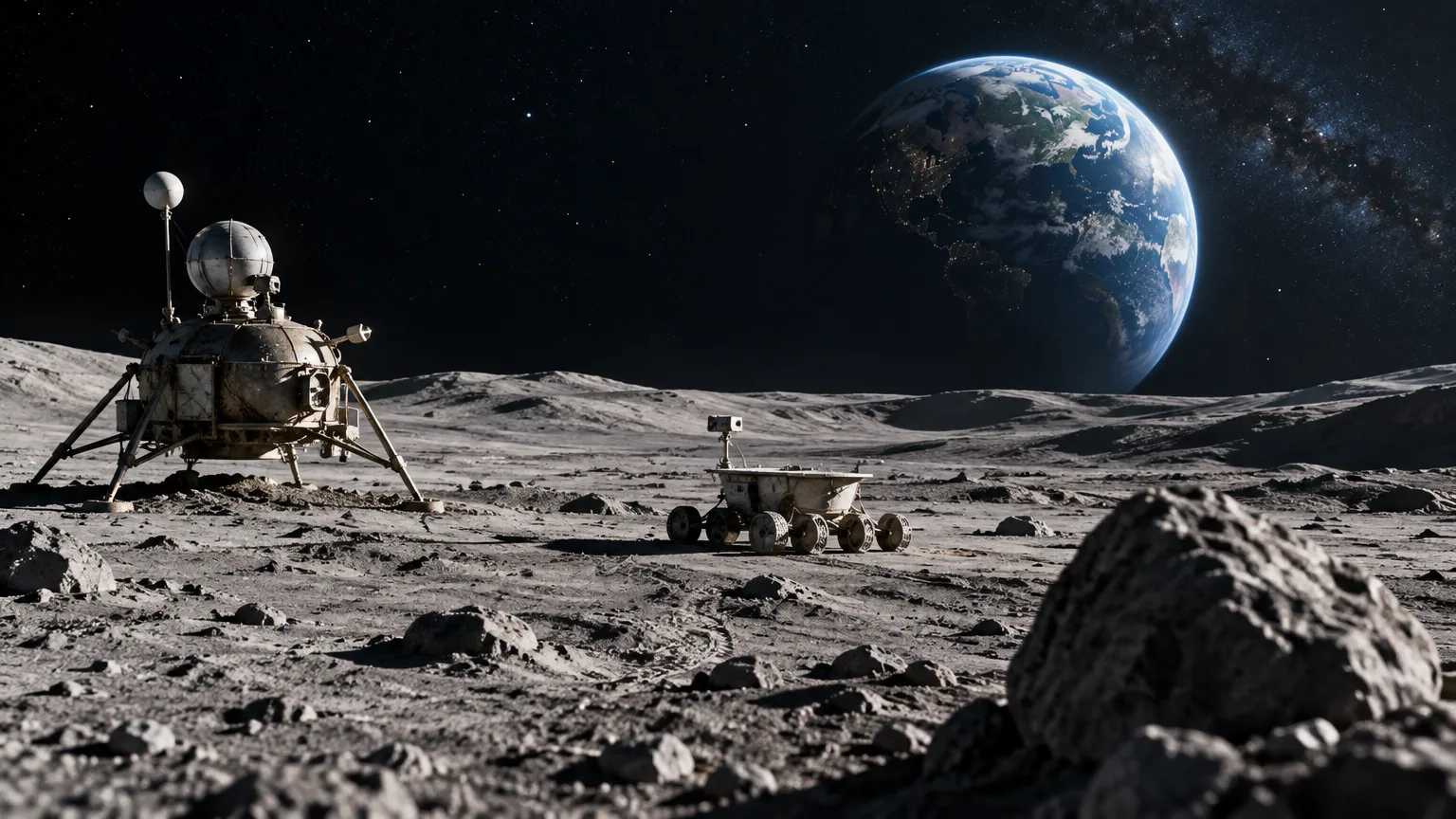
The Moon preserves a record of processes stretching back about 4.5 billion years, including planetary accretion, impacts, volcanism, and long-term surface modification. A review published online on September 30, 2026, revisits part of that record through the Soviet Luna program. The program operated from 1958 to 1976 and achieved robotic lunar landings, rover traverses, and automated sample returns.
The article, titled Soviet Lunar Science in Context: From Luna to Artemis and authored by Ulkar Karimova, Yu Yi, and Kyungguk Min, appeared in the Journal of Astronomy and Space Sciences. It is identified as a review paper: it synthesizes scientific findings attributed to earlier missions rather than announcing new measurements from a newly flown mission. The review organizes its aims around the physical properties of regolith, surface geochemistry, geological processes, and geophysical measurements, and also considers how this history relates to current and planned missions.
Two programs, different ways of observing
The Apollo program carried astronauts to the Moon and, according to the review, concentrated its landings near the lunar equator. It returned 382 kg of samples and deployed geophysical instrument networks, including passive seismometers. Luna took a robotic approach: it targeted different locations across a broader range of latitudes, used mobile platforms such as Lunokhod 1 and Lunokhod 2, and achieved automated sample returns from mare and highland terrain.
The review lists Luna 2, Luna 3, Luna 9, Luna 10, and Luna 16 among the program’s milestones. Luna 2, launched in September 1959, achieved the first successful lunar impact. Its instruments transmitted data during the final descent. The review explains that these measurements showed no radiation trapping comparable to Earth’s magnetosphere, implying that the Moon lacks a detectable global magnetic field. From this information, it reports an estimated upper bound for the lunar magnetic moment of about 10−4 of the strength of Earth’s magnetic field.
Luna 3, launched in October 1959, flew past the Moon and obtained images of its far side. Because the Moon is tidally locked, that side is not visible from Earth. The spacecraft developed and scanned photographic film on board; transmission followed later. According to the review, the images showed extensive areas that had not previously been observed and provided the first global view of that region.
Regolith: grain size and density
One scientific result highlighted by the review is that regolith grains become larger with depth. The article summarizes a change from 70 to 130 μm. It also reports that density rises from 0.8 to 1.2 g/cm3 with depth. Taken together, the review describes material that is coarser-grained and denser at greater depth. These are the figures the synthesis presents for this result; that passage of the summary does not give further detail about the particular locations or measurement conditions.
Regolith is the loose material covering the lunar surface. Studying it is part of the investigation of lunar physical properties and surface processes that the review identifies as one of its main areas. The article brings together the grain-size and density figures as findings from the Luna program and presents them in relation to depth.
Geochemical gradients and magnetic anomalies
A second finding is the presence of lateral geochemical gradients across mare-highland boundaries. The wording indicates geochemical changes across those terrain boundaries. The review’s summary gives no numerical values for the gradients’ magnitude and does not specify in that passage which elements or compounds characterize them.
The third highlighted finding is localized magnetic anomalies of 20–30 nT, described by the review as impact-generated. Their localized scale is distinct from the conclusion about a detectable global magnetic field: the article says the Moon has no such global field but does exhibit crustal magnetic anomalies. It also notes, as context, that subsequent investigations have refined understanding of lunar magnetic properties. In its summary, the anomalies are described as impact-related; when discussing later investigations, the review also mentions impact-related magnetization or possible remnants of an ancient dynamo.
What the comparison with Apollo shows
In comparing Luna data with Apollo data, the review finds broad agreement, alongside differences it attributes to landing-site geology and instrument characteristics. It does not present the two programs as sources of identical observations: their strategies and locations differed, and Apollo obtained samples and measurements through crewed missions while Luna used robotic spacecraft, mobile vehicles, and automated sample returns.
The article proposes evaluating the Luna and Apollo datasets as a combined observational framework. In doing so, it emphasizes both instrument-dependent differences and geological variability. That is the context the review gives for understanding how the results can agree broadly while differing in particular respects.
From Luna’s history to Artemis
The review says that Luna’s operational methods remain relevant to Artemis and highlights engineering lessons from Luna 24’s core drilling for drilling mechanisms planned for the lunar South Pole. The article identifies this as a technical connection between the experience of an earlier mission and mechanisms intended for future exploration.
The text also places Luna’s findings alongside later orbital observations. The missions it names include Kaguya, Chandrayaan-1, the Chang’e program, Lunar Reconnaissance Orbiter, GRAIL, and Danuri, also known as the Korea Pathfinder Lunar Orbiter. According to the review, these missions have helped refine global models of composition, gravity, and polar volatiles. The article thus describes an expanded observational framework in which Luna and Apollo data are considered alongside those from later missions.
Scope and limits of the review
The review notes that a significant share of Luna’s original technical literature remains available primarily in Russian. It says that, where possible, it incorporates primary sources and accessible English-language syntheses to support methodological clarity and coverage. This documentary limitation is part of the context the article describes in bringing together findings from a historic series of missions.
The results quantified in the review’s summary are specific: grain size from 70 to 130 μm, density from 0.8 to 1.2 g/cm3 with depth, and localized magnetic anomalies of 20–30 nT. The summary also identifies geochemical gradients between maria and highlands without quantifying them there. For Apollo, it reports 382 kg of returned samples and a comparison with Luna that finds broad agreement alongside differences associated with geology and instruments. The review’s contribution is to gather these findings and set them alongside later observations and Luna 24 engineering lessons for future lunar drilling.