

Key facts
- The original study reported radial velocity measurements of LB-1 obtained over two years.
- The initial interpretation estimated the dark companion at 68 solar masses, with an uncertainty of −13 and +11 solar masses, and described an orbit of 78.9 days.
- Abdul-Masih and colleagues attributed the apparent Hα displacements to the orbital motion of the B-type star, not the black hole.
- The original authors' response favored a range of 23–65 solar masses for the black hole and 5–8 solar masses for the donor star.
- The response indicated that other lower-mass solutions were possible, though less probable, and that more Gaia astrometry would help distinguish them.
Related records
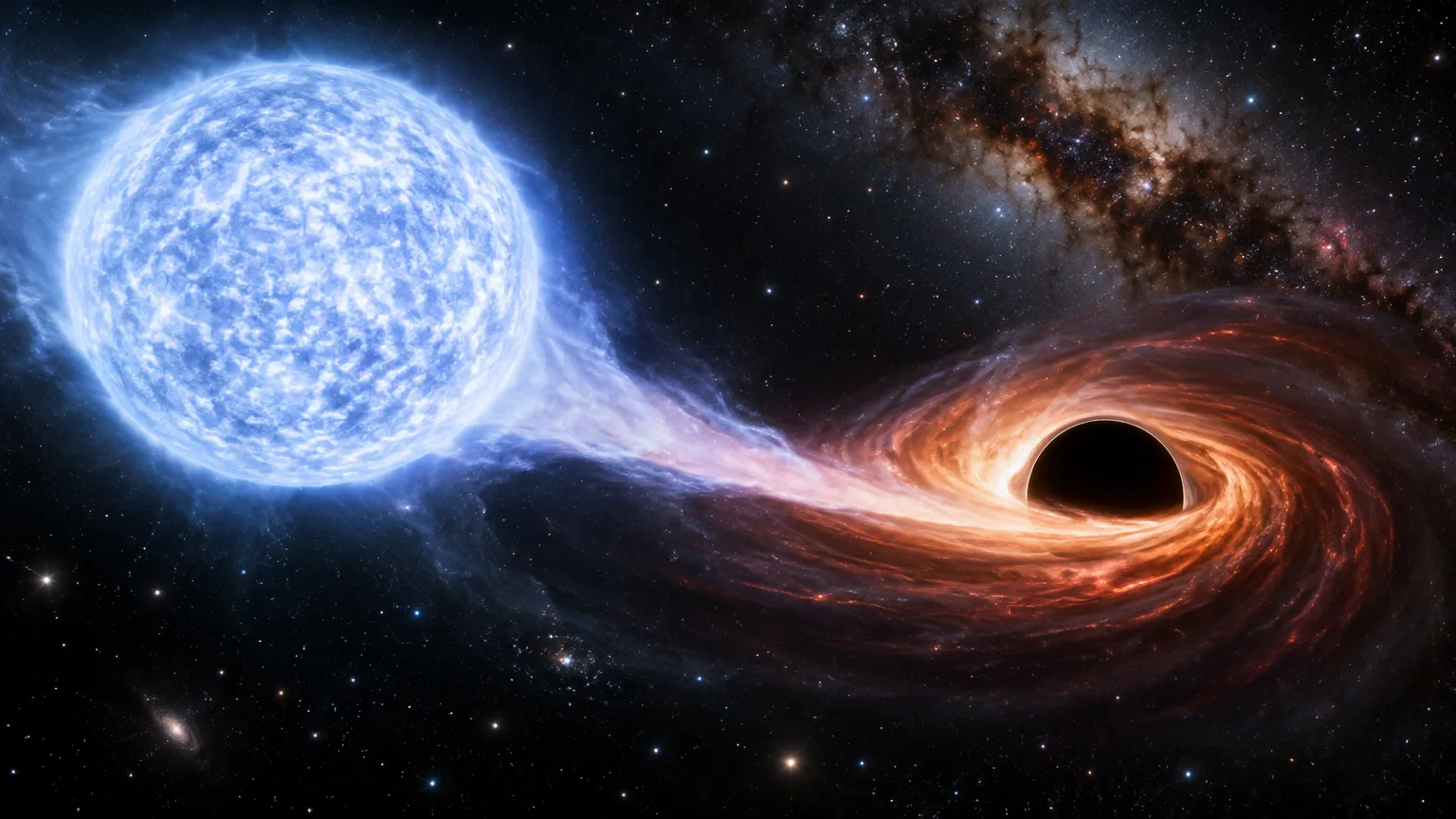
The LB-1 system became a prominent case in the debate over how to identify and measure a black hole accompanying a star. The dispute did not revolve solely around a figure: it depended on how to interpret the motion of a spectral line and which object in the binary system was being tracked with that signal. The available articles describe three steps in that discussion: the initial estimate, a critique of its interpretation, and the response from the original authors.
The initial proposal: a very massive dark companion
In the original article, published in Nature on November 27, 2019, Jifeng Liu and colleagues reported radial velocity measurements of the LB-1 star over two years. Radial velocity indicates the motion of an object toward or away from the observer, deduced from the displacement of its spectral lines. LB-1 was described as a B-type galactic star within a binary system: two objects bound to orbit around a common center of mass.
The team jointly interpreted the motion of the visible star and a hydrogen emission line known as Hα. According to their analysis, these signals required a dark companion with an estimated mass of 68 solar masses, with a reported margin of −13 and +11 solar masses. The authors concluded that the object could only be a black hole. They also described the system as a wide binary, with an orbital period of 78.9 days.
The proposal had implications for the formation of stellar black holes. The initial article noted that gravitational wave experiments had detected black holes of similar mass, but that forming such a massive one in a high-metallicity environment—that is, with a relatively high abundance of elements heavier than hydrogen and helium—was very difficult within the stellar evolution theories considered by its authors. This difficulty gave relevance to the LB-1 interpretation, but did not by itself resolve the mass of its companion.
The Hα line, center of the disagreement
A subsequent critique was published in Nature on April 29, 2020. Michael Abdul-Masih and colleagues argued that the apparent displacements of the Hα line used to estimate the mass did not follow the black hole's motion. According to their interpretation, they were due to the orbital motion of the B-type companion star. With this reading, they argued that the data showed no signs of a massive black hole and that the tension with formation models at galactic metallicity disappeared.
The difference between both positions is important for understanding what was being measured. Spectroscopic observation records changes in light; inferring which component produces them requires interpreting the profile and displacement of the lines. If the Hα signal is attributed to one object or another, the reading of the relationship between the visible star's motion and its dark companion's changes. Therefore, the discussion did not consist simply of choosing between two numbers: it involved reviewing the link between the spectral signal and the objects' orbit.
The response maintains a broad range
On that same April 29, 2020, Liu and colleagues published a response to the critique in Nature. They explained that they were re-examining the initial arguments in light of more recent spectroscopic observations and additional analyses. Their conclusion was that the data still favored a very high mass for the black hole: between 23 and 65 solar masses. For the donor star, the response indicated a more probable mass range of 5 to 8 solar masses.
The response did not present that range as the only possible solution. Its authors acknowledged that lower-mass solutions could exist, although they considered them less probable. They also pointed to a specific condition to settle the difference between the solutions: more astrometric data from Gaia, the European Space Agency's space mission that performs position and motion measurements of stars, would be needed. In the text, these data appear as a future necessity to definitively distinguish the alternatives, not as a confirmation already obtained.
What remains established in the cited works
The three publications offer a bounded record of a scientific controversy. The 2019 article reported an estimate of 68 solar masses from two years of radial velocities and the joint interpretation of the B star and Hα. The 2020 critique proposed that the apparent motion of Hα corresponded to the visible star. The original authors' response maintained a favored range of 23–65 solar masses, acknowledged less massive alternatives, and explained that additional Gaia astrometric data would help separate the possibilities.
Thus, the result that can be described with these works is not an isolated figure, but a sequence of measurement, interpretation, and revision. The documented disagreement focuses on the origin of the apparent motion of Hα and the masses deduced from that reading. The response preserves a very high-mass solution as favored by its authors, but explicitly leaves open that other solutions exist and that the definitive distinction depends on new astrometry. This precision allows recounting the case without turning a debated interpretation into a conclusion shared by all teams.