

Key facts
- The “Space Vehicles for Exploration & Propulsion for Deep Space” conference took place in New Delhi from May 7 to 9, 2025.
- Amogh Wagh is listed as the author of “Hybrid Solar Sail and Electric Propulsion System for Deep-Space Exploration,” pages 284–298 (15 pages).
- Shivanandanan P, Mekhala Hejib and Akshita Singh are listed as the authors of “Modular Solar Sail System for Enhanced Deep Space Exploration and Sustainability,” pages 166–172 (7 pages).
- The Aerospace Corporation describes solar-sail thrust as resulting from the radiation pressure of light on a reflective material.
- The IKAROS mission flew in 2010; according to a NASA document, it verified the effects of solar radiation pressure on the sail and in-flight guidance and navigation techniques.
Related records
Two papers in the proceedings of the “Space Vehicles for Exploration & Propulsion for Deep Space” conference, held by the International Astronautical Federation (IAF) in New Delhi from May 7 to 9, 2025, have titles related to solar sail systems and deep-space exploration. The available bibliographic data describe the papers and their place in the proceedings; they do not provide enough content to summarize their methods, performance or results.
The papers and their bibliographic details
- “Hybrid Solar Sail and Electric Propulsion System for Deep-Space Exploration”, by Amogh Wagh, spans pages 284–298 (15 pages). Its title identifies the subject as a solar sail and electric propulsion system.
- “Modular Solar Sail System for Enhanced Deep Space Exploration and Sustainability”, by Shivanandanan P, Mekhala Hejib and Akshita Singh, spans pages 166–172 (7 pages). Its title refers to a modular solar sail system.
The IAF is listed as the proceedings publisher. The conference is recorded as having taken place in New Delhi, India, from May 7 to 9, 2025. The titles indicate the papers’ general topics, but do not, by themselves, establish which architectures they describe or what results they obtained.
Context: how a solar sail works
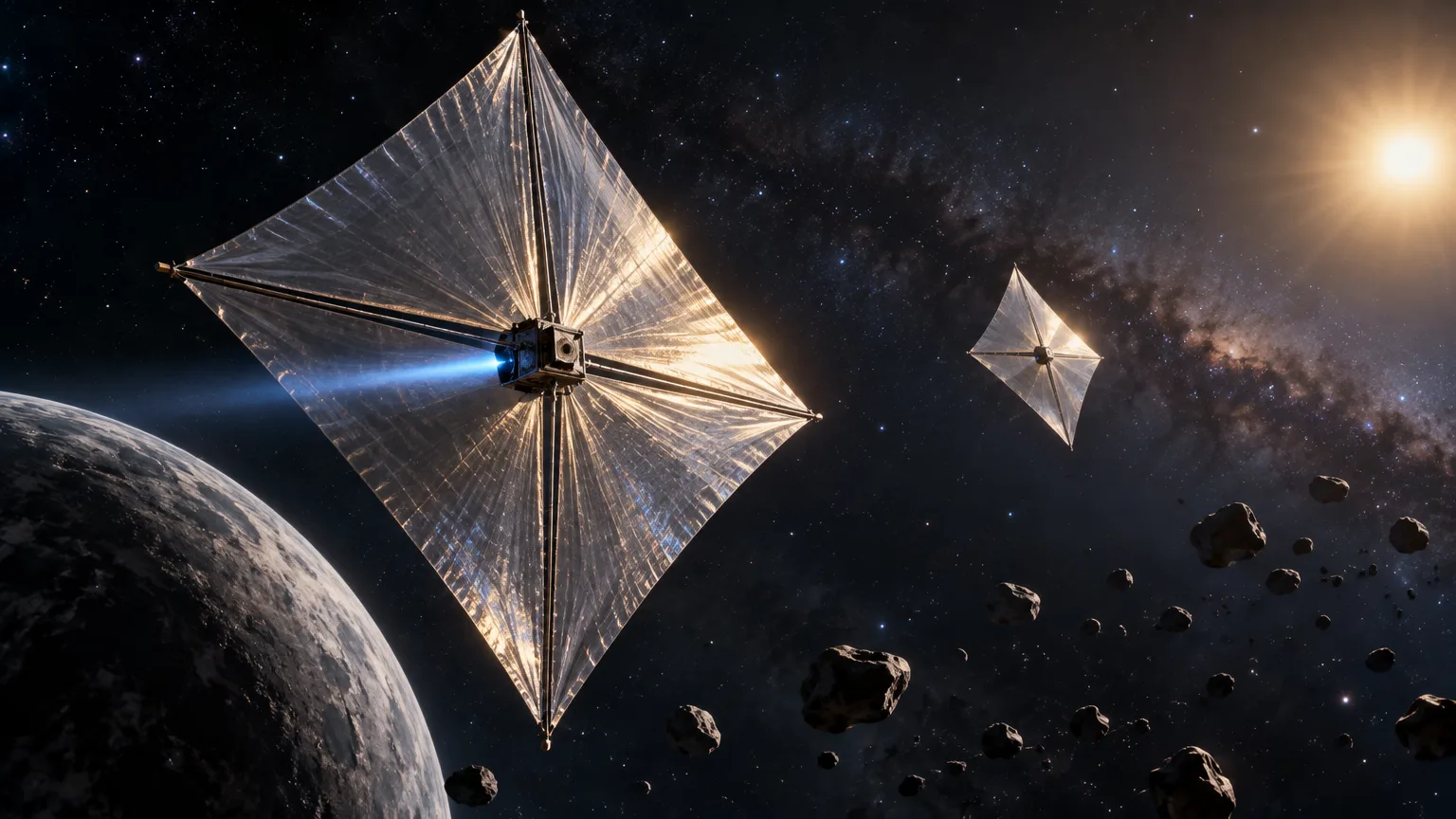
As context independent of these two papers, The Aerospace Corporation explains that a solar sail obtains thrust from the radiation pressure exerted by light on a reflective material. The organization notes that such sails have few moving parts and do not require onboard propellant, characteristics it associates with lower-cost operations and a long operational life.
The Japanese IKAROS mission, whose name stands for “Interplanetary Kite-craft Accelerated by Radiation Of the Sun,” flew in 2010 and was the first demonstration of solar sailing in deep space. A NASA document states that IKAROS verified the effects of solar radiation pressure on the sail and used in-flight guidance and navigation techniques with the sail.
Scope of the available information
The records for the two papers provide their titles, authors, page counts and connection to the conference. The content consulted does not detail how the proposals work, what performance they calculate, or what assumptions and results they present. Their titles alone therefore do not justify attributing conclusions to them about efficiency, speed, autonomy or mission capabilities.