

Key facts
- The Messier catalog contains 110 entries: 28 open clusters, 29 globular clusters, eight bright nebulae, four planetary nebulae, 40 galaxies, and the double star M40.
- NASA describes Messier objects as observable with binoculars or small telescopes under a relatively dark sky; some are also visible to the unaided eye.
- For M44, NASA’s March example recommends binoculars and using Pollux and Regulus as guide stars.
- NASA recommends Arcturus as a reference for M3 and Antares for M4.
- NASA recommends looking for M20 in August; its March examples include M65 and M66 under dark skies.
- The Astronomical League recommends recording the date and time, coordinates, seeing, transparency, aperture, magnification, and the object’s appearance in the eyepiece.
- Hubble combines monochromatic images taken at specific wavelengths; some images assign colors to infrared or ultraviolet observations.
Related records
The Messier catalog began as a practical tool. While searching for comets, Charles Messier recorded diffuse objects that could be mistaken for them. Today, its 110 entries form a popular selection of deep-sky objects, but they are not all the same type or observed in the same way.
The Royal Astronomical Society of Canada groups the list into 28 open clusters, 29 globular clusters, eight bright nebulae, four planetary nebulae, and 40 galaxies. M40 is a double star. This variety makes it possible to adapt a session to the equipment and conditions instead of treating the catalog as a list of equivalent targets.
Choosing what to observe
Start by considering the instrument available and how dark the sky is. NASA describes Messier objects as suitable targets for binoculars or small telescopes under a relatively dark sky; some are also visible to the unaided eye. The Astronomical League notes that, in good conditions, a three-inch reflector can reach the objects in the catalog. These references describe possibilities; they do not guarantee that an object will be visible from every location or on every night.
NASA recommends comparing the chosen object’s apparent magnitude with the sky’s limiting magnitude: the latter indicates how faint an object the observing sky allows you to distinguish. Sky conditions matter alongside the equipment. For a first session, it may be useful to choose an open cluster such as M44, which NASA says can be observed with binoculars, and save the galaxies in its March example for a telescope and a dark sky.
Preparing for a session with a star chart
Before heading out, consult a chart showing the object and the stars in its surroundings. NASA’s Messier catalog includes descriptions and star charts; it also offers an interactive sky map. The chart helps you recognize the field you will see from your location and prepare a route between stars, but it cannot ensure that the object will be visible under the specific conditions of your session.
The seasonal guidance available here is limited to examples; it is not a complete plan for all seasons and latitudes. For March, NASA places M44 high in the evening sky and mentions M65 and M66 in Leo, visible an hour after sunset under dark skies. For August, its catalog recommends looking for M20. Check the chart for your location and date: apparent position changes with time and place.
It is a good idea to choose a familiar location and prepare for the outing in advance. NASA advises observing on nights close to the new Moon and recommends bringing warm clothing for a long session, as well as charging the equipment and phone batteries if you plan to use them. If the telescope needs power, check its batteries before heading out too.
Finding the object using guide stars
Star-hopping means orienting yourself from recognizable stars and moving across the sky with the help of a chart until you reach the position you are looking for. The sources provide specific reference stars, but not a step-by-step route or a chart showing fields of view for every instrument. There is no need to pretend to have that level of precision: compare the stars on the chart with those you see in the sky and follow the indicated reference.
- M44, the Beehive Cluster: For the March example, NASA suggests using Pollux in Gemini and Regulus in Leo as guide stars. It notes that the cluster can be observed with binoculars.
- M3, a globular cluster: NASA recommends using Arcturus in Boötes as a reference. It describes the cluster’s appearance through a telescope as a fuzzy, sparkling ball; it notes that an eight-inch telescope can resolve the cluster under moderately dark skies.
- M4: NASA’s catalog points to Antares as a guide to finding it.
In its March guide, NASA suggests observing M65 and M66, two galaxies in the Leo Triplet, with a telescope under dark skies, and M87 with a medium-sized telescope. These are examples tied to the conditions specified by the source, not a promise of results for every observer.
Observing and keeping a record
Spend time looking through the eyepiece and describe the appearance you observe instead of substituting the object’s name or photograph for the observation. For a visual observing log, the Astronomical League asks observers to record the date and time, the location’s latitude and longitude, seeing and transparency, telescope aperture, magnification used, and a description of the object as it appears in the eyepiece. The Royal Astronomical Society of Canada offers forms with space for notes and drawings. A sketch can help preserve the arrangement you observed without needing to be a detailed image.
The Astronomical League’s observing program is designed to teach participants about the nature and locations of objects. Its visual certification requirements include locating the object and recording the observation; the organization says that observations made for its binocular Messier program should not be reused for this program. The Royal Astronomical Society of Canada, for its part, offers traditional certification—with star-hopping—and Go-To-assisted options.
The eyepiece and an astronomical image do not show the same thing
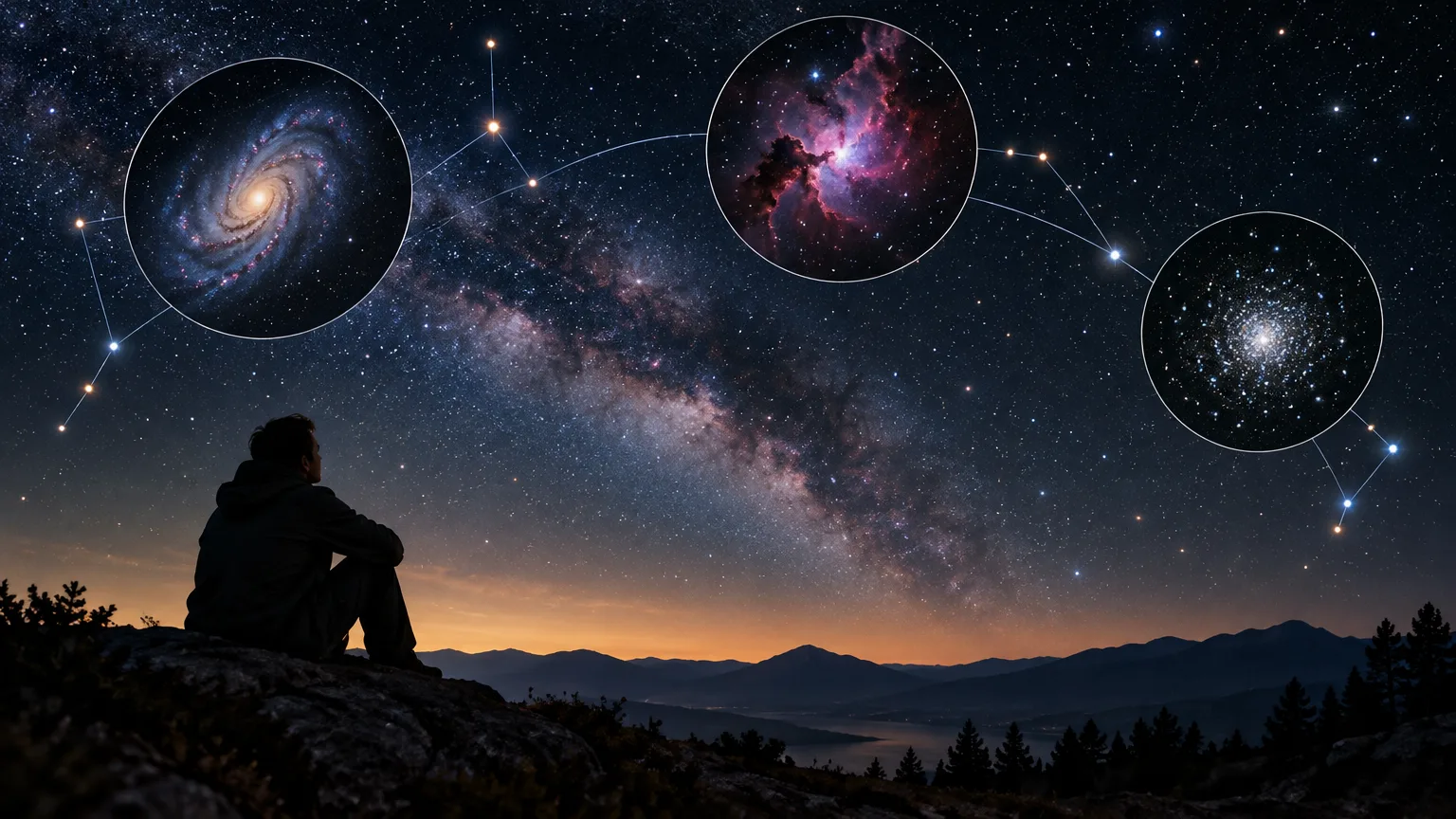
What you see through the eyepiece depends on what the observer can perceive with that instrument under the conditions of the session. A processed astronomical image can bring together information that does not appear in the same way in a direct view. For example, the Hubble Space Telescope takes monochromatic images at specific wavelengths; several observations can then be combined and assigned colors. Its infrared and ultraviolet observations are also represented using colors perceptible to people, even though the eye cannot see those wavelengths.
For this reason, a Hubble photograph is not a direct comparison with what appears in the eyepiece. Hubble also has a relatively small field of view. To create a mosaic of the Andromeda Galaxy, M31, it took thousands of exposures over more than ten years. NASA also presents amateur images of Messier objects made with an eight-inch Schmidt-Cassegrain telescope. These are different ways of exploring the sky: visual observing lets you describe the eyepiece experience; astronomical imaging combines exposures and processing to show information recorded by instruments.
A learning path, not a race
Choose a target suited to your equipment, check a chart and its guide stars, and take the darkness of the sky and the date into account. After finding the object, record which instrument you used and what it looked like in the eyepiece. Repeating this process with different kinds of objects—for example, the open cluster M44, the globular cluster M3, or the galaxies M65 and M66—helps you become familiar both with the Messier list and with the sky. The Astronomical League’s guide advises against trying to observe the entire catalog in one session: it recommends taking time to really observe each object.