

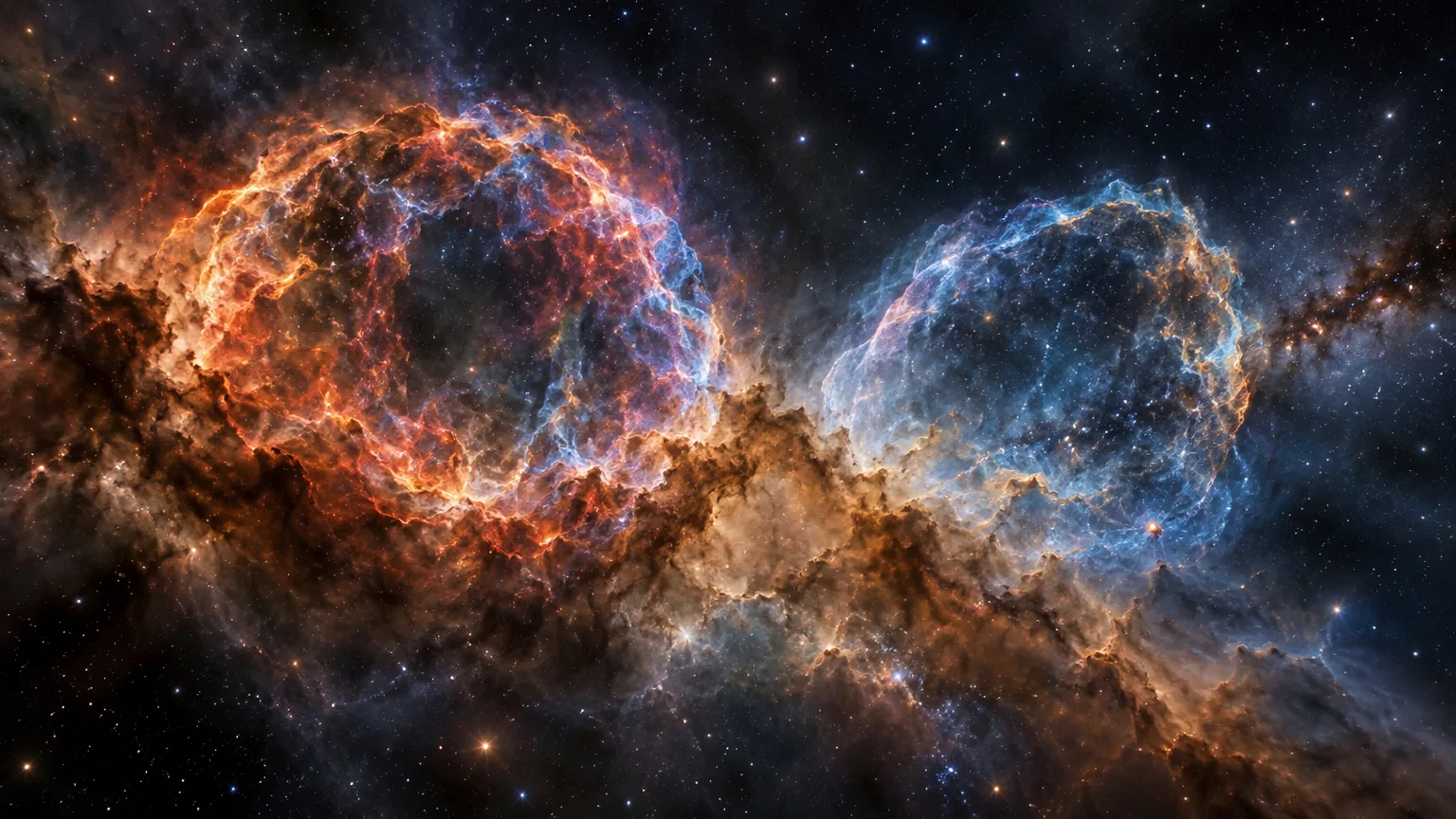
Key facts
- On June 17, 2026, NASA announced an analysis of 16 years of Fermi telescope data; the page was updated on June 18.
- The LAT instrument detected gamma-ray emission associated with accelerated protons in the northern part of G189.6+3.3.
- G189.6+3.3 was discovered in 1994 by ROSAT and is visible mainly in X-rays; it partially overlaps IC 443 in those images.
- Observations of a band of gas between the remnants indicate that G189.6+3.3’s shock wave slowed after colliding with dense gas; the team considers this evidence of interaction with the same cloud system.
- The team estimates that both remnants are about 6,000 light-years away and that their explosion centers are separated by about 40 light-years projected on the plane of the sky.
- Estimated ages are 8,000–9,000 years for IC 443 and 20,000–110,000 years for G189.6+3.3; the delay between the explosions could reach 100,000 years.
- Simulations of one million massive binary systems produced paired explosions with similar separations and delays in systems involving mass exchange and interaction.
- The team estimated at less than 1% the probability of finding the observed combination of spatial alignment and compatible distances by chance.
Related records
The Medusa Nebula (IC 443) has a fainter neighbor, the remnant G189.6+3.3. A study publicized by NASA on June 17, 2026, proposes that both could be the detectable remains of two stars that were bound in a binary system: the first star’s explosion may have sent its companion hurtling through space, and thousands of years later the survivor may also have exploded. NASA’s page states that it was updated on June 18.
The association is the team’s interpretation, not a direct observation of the progenitor stars. Miltiadis Michailidis, a postdoctoral researcher in Stanford University’s Department of Physics, presented the findings at the 248th meeting of the American Astronomical Society, held in Pasadena, California. NASA said the paper describing the study would appear in a future issue of Nature Communications.
Fermi’s signal from G189.6+3.3
Fermi is NASA’s space-based gamma-ray telescope; its Large Area Telescope (LAT) observes this form of high-energy light. Using 16 years of LAT data, the team found gamma-ray emission associated with accelerated protons in the northern part of the fainter remnant, G189.6+3.3.
NASA’s account explains that cosmic-ray protons can collide with interstellar gas and produce neutral pions, which almost immediately decay into gamma rays. In 2013, Fermi observations showed that IC 443 produced gamma rays through this mechanism as it interacted with part of a bright hydrogen cloud called Sharpless 249.
G189.6+3.3 was discovered in 1994 during an X-ray survey by the ROSAT mission, an X-ray satellite led by Germany. The remnant is visible mainly in X-rays; IC 443 is its brighter, better-known neighbor. The two objects, in the constellation Gemini, appear to overlap partially in X-ray images.
A shared cloud and compatible distances
A bright band of gas is visible between the remnants. New observations of this structure show that G189.6+3.3’s shock wave collided with dense interstellar gas and slowed markedly. The team considers this key evidence that both remnants are interacting with the same cloud system. NASA’s description indicates that the shared molecular cloud appears red, orange and brown in infrared and radio data.
If the two remnants interact with the same structure, the team reasons, they must be at a common distance from Earth. Its estimate places both remnants about 6,000 light-years away. The explosion centers would be separated by about 40 light-years projected on the plane of the sky; the original stars may have had masses equal to or greater than 20 times the Sun’s mass.
Ages and simulations
Age estimates vary widely. The team calculates an age of 8,000 to 9,000 years for IC 443 and 20,000 to 110,000 years for G189.6+3.3. Given these ranges, the delay between the explosions could have been as long as 100,000 years.
The researchers also simulated one million massive binary systems. The simulations show that systems in which the stars orbit close enough to exchange matter and interact during their lifetimes can produce two supernovae with separations and delays similar to those estimated for these remnants.
The team estimated the probability of finding the observed combination of spatial alignment and compatible distances by chance at less than 1%. According to NASA, this calculation strongly supports a physical association between the remnants. Taken together, observations at different wavelengths, the objects’ properties and the simulations support the interpretation of a possible episode of two supernovae in an ancient binary system.