

Key facts
- Euclid is an ESA mission, built and operated by the agency with contributions from NASA.
- The main survey will map billions of galaxies across more than a third of the sky.
- The ESA says Euclid will use gravitational lensing to measure indirectly the amount and distribution of dark matter in clusters and other regions.
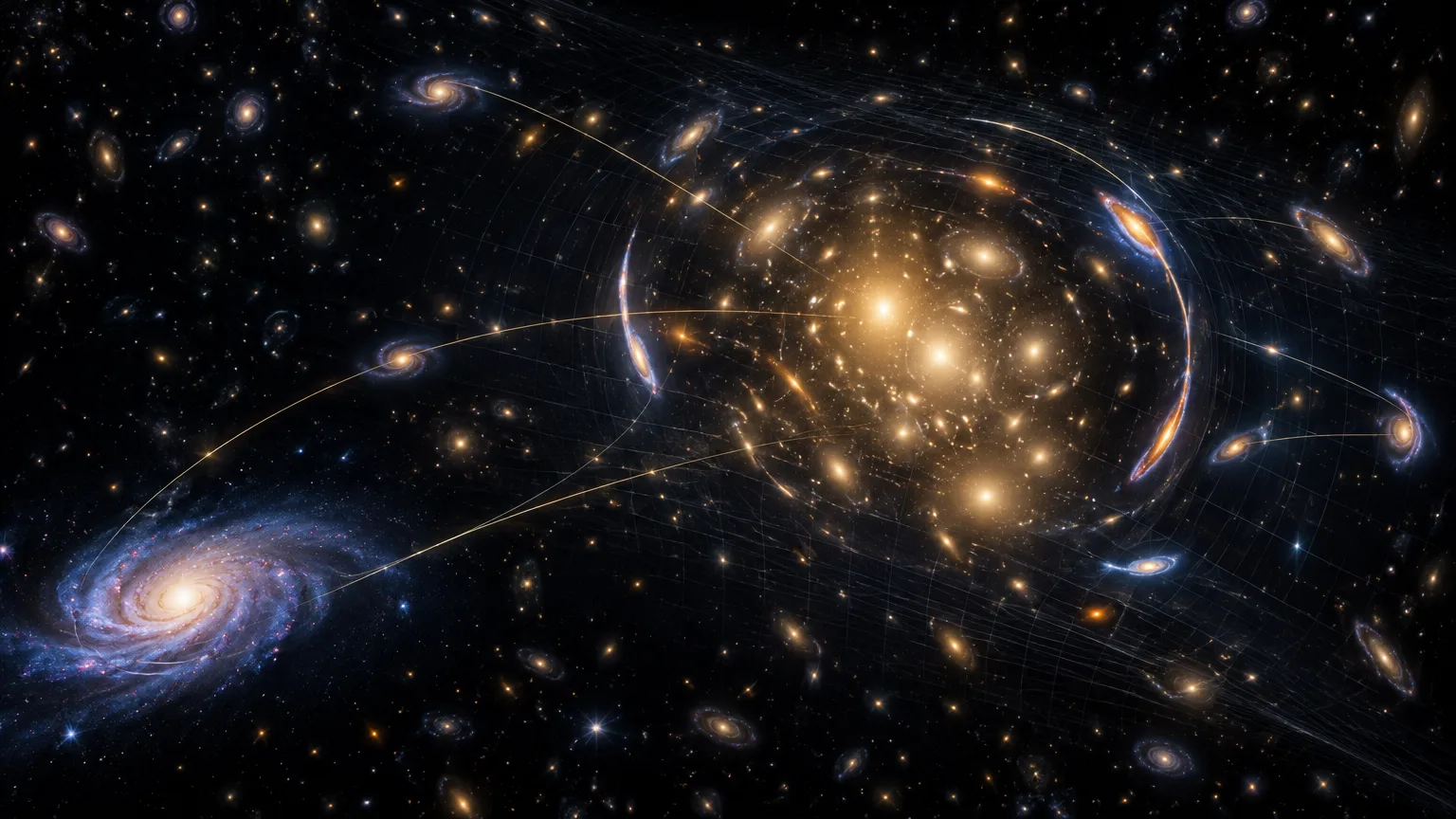
- The image of Abell 2390 revealed more than 50,000 galaxies and large gravitational arcs; some arcs are multiple images of the same distant object.
- The Euclid Consortium brings together more than 2,000 scientists from 300 institutes in 15 European countries, the United States, Canada, and Japan.
Related records
Cosmology studies the structure and evolution of the universe. Central questions include the nature of dark matter and dark energy. The European Space Agency’s (ESA) Euclid mission, built and operated by the agency with contributions from NASA, was designed to explore these components and reconstruct aspects of cosmic history through observations of galaxies and galaxy clusters.
Euclid’s main survey will map billions of galaxies across more than a third of the sky. The ESA describes this map as a tool for studying how the universe formed and evolved over cosmic history. The distribution of galaxies and observations of gravitational lenses offer related but distinct approaches to studying that structure.
What a gravitational lens reveals
Gravity bends and distorts the light arriving from distant galaxies. When light passes through the region of a cluster or another concentration of matter, it can appear as arcs and as multiple images of the same distant object. This effect is known as gravitational lensing.
Euclid will use these distortions to investigate indirectly the amount and distribution of dark matter in galaxy clusters and other regions. Dark matter is studied here through its gravitational effects on light, not through an image of light emitted by the matter itself.
Abell 2390: a sample of the observations
In Euclid’s first public observations, its image of Abell 2390, a galaxy cluster, revealed more than 50,000 galaxies. The ESA highlighted the large curved arcs visible in the image and noted that some are multiple views of the same distant object. The scene provides an observable example of gravitational lensing and of the kind of phenomenon Euclid will use to study dark matter.
The ESA also reported that mission scientists are studying how the masses and numbers of galaxy clusters have changed over time. These observations are intended to provide information about the history and evolution of the universe. In this way, early images of individual objects are part of a broader program of cosmological mapping.
A mission and an international collaboration
Euclid is a European mission built and operated by the ESA, with contributions from NASA. According to the agency, the Euclid Consortium brings together more than 2,000 scientists from 300 institutes in 15 European countries, the United States, Canada, and Japan; the consortium is responsible for providing the scientific instruments and analyzing the scientific data. The ESA selected Thales Alenia Space as prime contractor for the satellite and its service module, and Airbus Defence and Space to develop the payload module, including the telescope. NASA provided detectors for the Near Infrared Spectrometer and Photometer (NISP).
Euclid’s cosmological reach comes from combining an extensive galaxy map with measurements of observable gravitational effects. Abell 2390 shows how these effects appear in an image; the mission’s broader goal is to gather large-scale observations to study cosmic structure and evolution, as well as to measure indirectly where dark matter is distributed.