

Key facts
- NASA describes the cosmic microwave background as the oldest light we can observe in the universe.
- NASA’s glossary states that baryonic matter represents 4.9% of the mass-energy of the universe.
- BAO are reflected in CMB temperature variations and leave a faint signal in the clustering of galaxies.
- According to NASA’s glossary, the BAO signal includes a small excess of galaxy pairs separated by about 500 million light-years; the source does not specify the distance convention here.
- ESA says Euclid will observe billions of galaxies up to 10 billion light-years away, across more than one-third of the sky, to create a three-dimensional map.
- ESA states that Euclid launched on July 1, 2023, and is destined for the second Lagrange point of the Sun–Earth system, 1.5 million kilometers from Earth.
Related records
Cosmology studies the origin, evolution and nature of the universe. NASA notes that discoveries in the 20th century transformed this discipline, although aspects of the cosmos remain unknown. To reconstruct its history, researchers connect observations from different eras and study, among other things, expansion and the formation of structures.
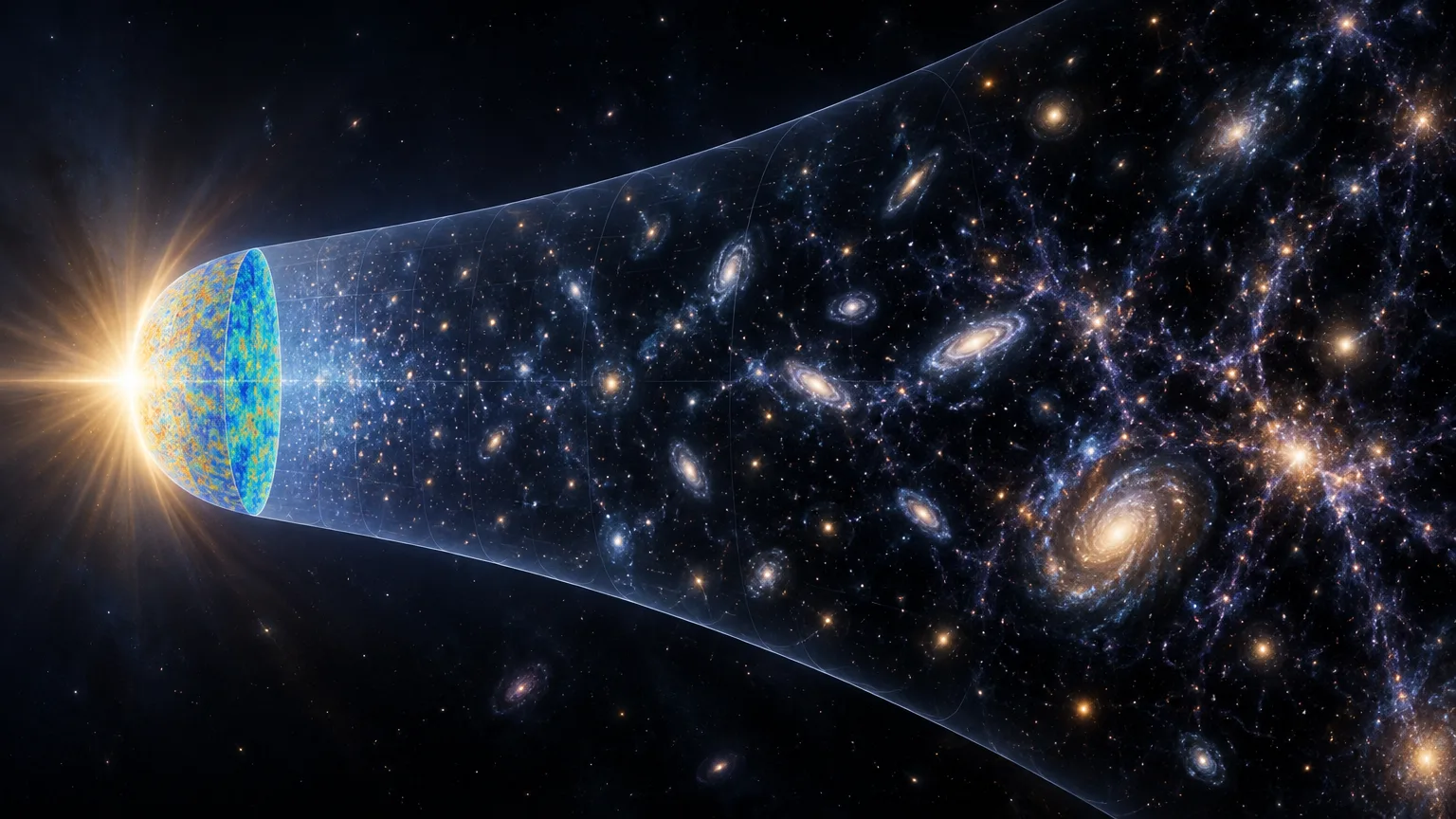
One of the fundamental signals is the cosmic microwave background (CMB), which NASA describes as the oldest light we can observe in the universe. Another approach is to measure how galaxies cluster across vast distances. These are distinct records: the CMB displays temperature variations, while the distribution of galaxies shows the large-scale cosmic structure.
The imprint of acoustic waves
In the early universe, matter and light formed a hot, dense plasma. According to NASA’s glossary, regions with greater concentrations of light and matter had more pressure, causing sound waves to propagate outward and drag ordinary, or baryonic, matter along with them. When the universe cooled enough for light to travel freely, the cosmic microwave background formed.
The movement of matter associated with these waves produced spherical shells with an excess density. NASA explains that baryon acoustic oscillations (BAO) are reflected in CMB temperature variations and today leave a faint imprint on galaxy clustering. The glossary describes this signal as a small excess of pairs of galaxies separated by about 500 million light-years; the source does not specify the distance convention used here.
The scale of these features serves as a “standard ruler.” By measuring it in the distribution of galaxies, astronomers can study the universe’s expansion rate and gain information about dark energy, according to NASA. Thus, an imprint from the early universe provides a tool for investigating cosmic evolution.
Baryonic matter and the composition of the universe
NASA’s glossary uses baryonic matter to refer, in astronomy, to ordinary matter that forms, among other things, atoms, people, planets, stars and galaxies. The source states that it represents 4.9% of the mass-energy of the universe. The percentage and the expression “mass-energy” are presented here as formulated in the glossary.
Euclid: mapping galaxies on a large scale
ESA designed Euclid to explore the composition and evolution of the so-called dark universe by studying cosmic structure. The mission will observe billions of galaxies at distances of up to 10 billion light-years, across more than one-third of the sky, to create a large three-dimensional map of the universe. ESA states that Euclid launched on July 1, 2023, and that its destination is the second Lagrange point of the Sun–Earth system, 1.5 million kilometers from Earth.
Using this map, Euclid will study how the universe expanded and how its structures formed throughout cosmic history. ESA says the observations will help investigate the role of gravity and the nature of dark matter and dark energy. These are questions the mission will address through its observations of galaxies and large-scale structure.
The cosmic microwave background and galaxy maps offer complementary records. CMB temperature variations preserve information about the early universe; the BAO signal in galaxy clustering makes it possible to use a known scale to study expansion. Euclid will extend observations of this structure across space and cosmic history.