

Key facts
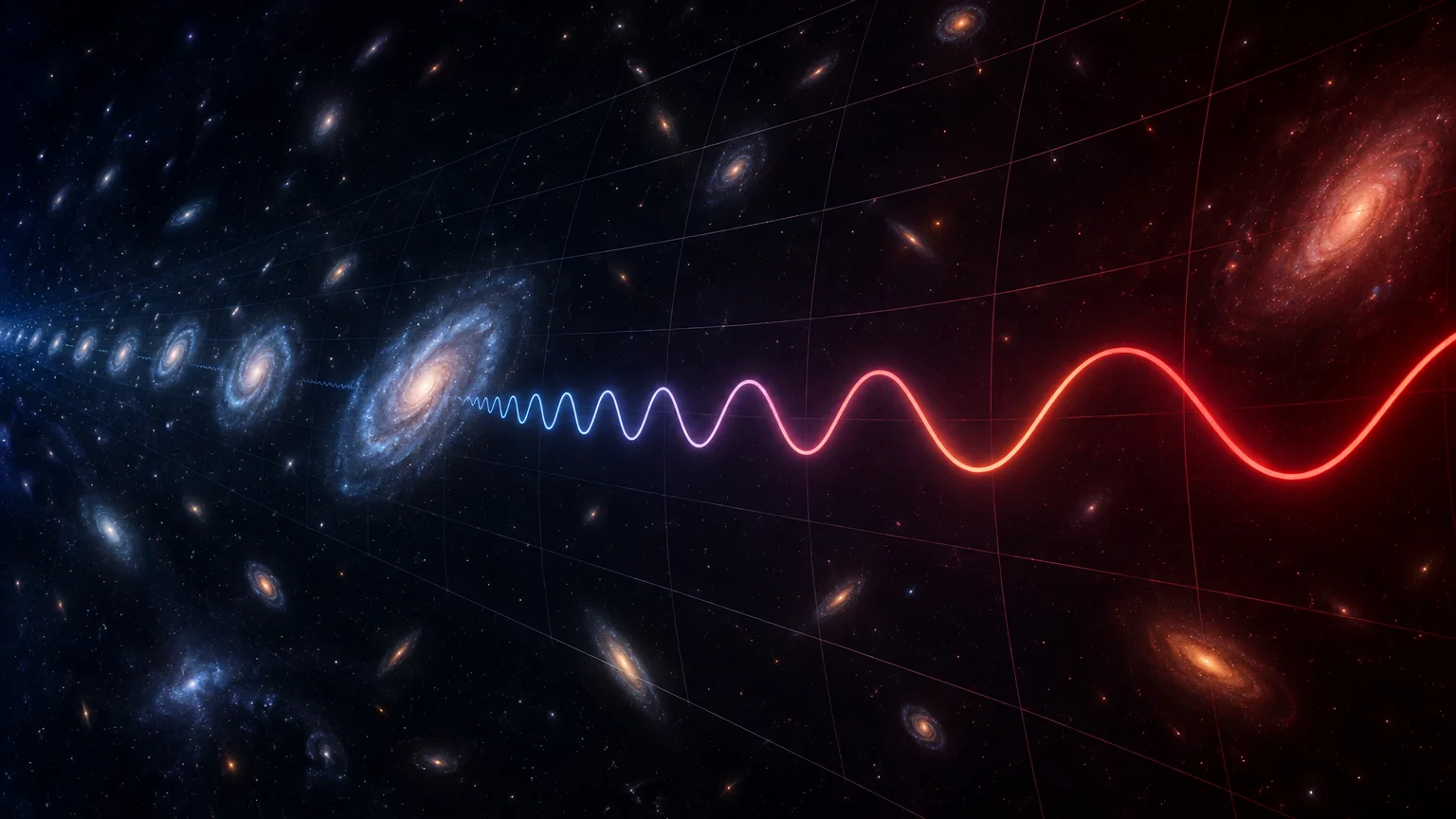
- NASA explains that the expansion of the universe stretches light and increases its wavelength, shifting it toward the red.
- Redshift can be measured by comparing known features in an observed spectrum with their reference positions; ESA specifies atomic emission or absorption lines and laboratory spectra.
- ESA distinguishes Doppler shift, associated with relative motion through space, from cosmological redshift, caused by the expansion of space.
- NASA notes that light from more distant objects takes longer to arrive, allowing us to observe earlier eras of the universe.
- NASA places the start of the expansion's acceleration about five billion years ago and attributes it to dark energy.
Related records
Light from a distant galaxy can arrive with a longer wavelength than it had when it was emitted. Because longer wavelengths lie toward the red end of the visible spectrum, the phenomenon is called redshift. In the cosmological case, light stretches as it travels through an expanding universe.
How it is measured
Astronomers analyze the spectrum of received light and look for features with known reference positions. NASA cites absorption lines as one example: by comparing their observed locations with their normal positions in the spectrum, scientists determine the cosmological redshift.
The European Space Agency explains that atoms emit and absorb light at known wavelengths. A spectrum from a distant galaxy or quasar can therefore be compared with a laboratory reference spectrum to measure how far those lines have shifted.
Expansion of space and the Doppler effect
Cosmological redshift is related to the Doppler effect, which also shifts waves when a source and an observer move relative to one another. But ESA distinguishes the two cases: ordinary Doppler shift is caused by relative motion through space, whereas cosmological redshift is caused by the expansion of space itself. Thus, two objects at rest relative to their local surroundings can observe a redshift if the space between them expands.
ESA offers the analogy of raisins in bread dough. Before baking, the raisins are at rest within the dough; as it rises, the distance between them increases. The comparison illustrates how separations grow during expansion and does not describe every detail of the universe.
What it reveals about the universe
NASA's page about the Hubble Space Telescope notes that, in general, the farther away a galaxy is, the greater its redshift. The relationship between a galaxy's distance and how fast it is receding is known as Hubble's law. Spectroscopy—the study of light broken down into its components—enabled Edwin Hubble to confirm that galaxies are moving away; the space telescope named after him has helped improve the precision of measurements of the expansion rate.
Redshift also offers a window onto cosmic history. Light from distant objects takes longer to arrive, so we see them as they were when they emitted it. As light stretches, it can move from the visible range into the infrared. Hubble has detectors sensitive to ultraviolet, visible, and infrared light; the James Webb Space Telescope, with its infrared vision, extends observations to older galaxies and enables some remote galaxies to be studied again.
Expansion over time
According to NASA's explanation, the universe's initial expansion began to slow almost immediately under the influence of gravity, then began accelerating again about five billion years ago. NASA attributes this acceleration to dark energy. The same page describes redshift and expansion measurements made with Hubble as tools for studying how the universe changes.
Together, measuring spectra connects an observable signal—the shift in features of light—with the expansion of space and the time when that light began its journey.