

Key facts
- Gravity binds the stars and other components of a galaxy.
- The Milky Way and Andromeda are two separate spiral galaxies.
- A galaxy’s tilt can hide its spiral arms in an image.
Related records
What holds a galaxy together?
A galaxy is a system of stars and other components bound by gravity. It can contain planets, clouds of gas, and dust. A planetary system, such as ours, is much smaller. Our planets orbit the Sun, and together with it they are part of the Milky Way. A bright point in the sky can be a nearby star or the combined light of something much farther away.
Stars emit light. Some gas can shine, while dust in front of bright areas can dim visible light and leave dark lanes. Stars form in clouds of gas and dust. Astronomers infer dark matter through its gravitational effects, such as the way stars move in a galaxy. A dark lane in a photograph is no detection of dark matter.
How to recognize common galaxy shapes
Spiral galaxies have a disk and curved arms. Those arms are easier to see when a disk faces us. Seen edge-on, the same kind of galaxy can look like a narrow band with a central bulge. Elliptical galaxies usually look round or oval and have a smoother glow with no spiral arms. They tend to contain less gas and dust than spirals.
Irregular galaxies come in varied shapes without the characteristic pattern of a spiral or an elliptical. Lenticular galaxies also exist: they have a disk and central bulge but lack prominent spiral arms. The classification describes features we can observe. A blurry image or an awkward viewing angle can leave the type uncertain.
Where we are: the Milky Way and Andromeda
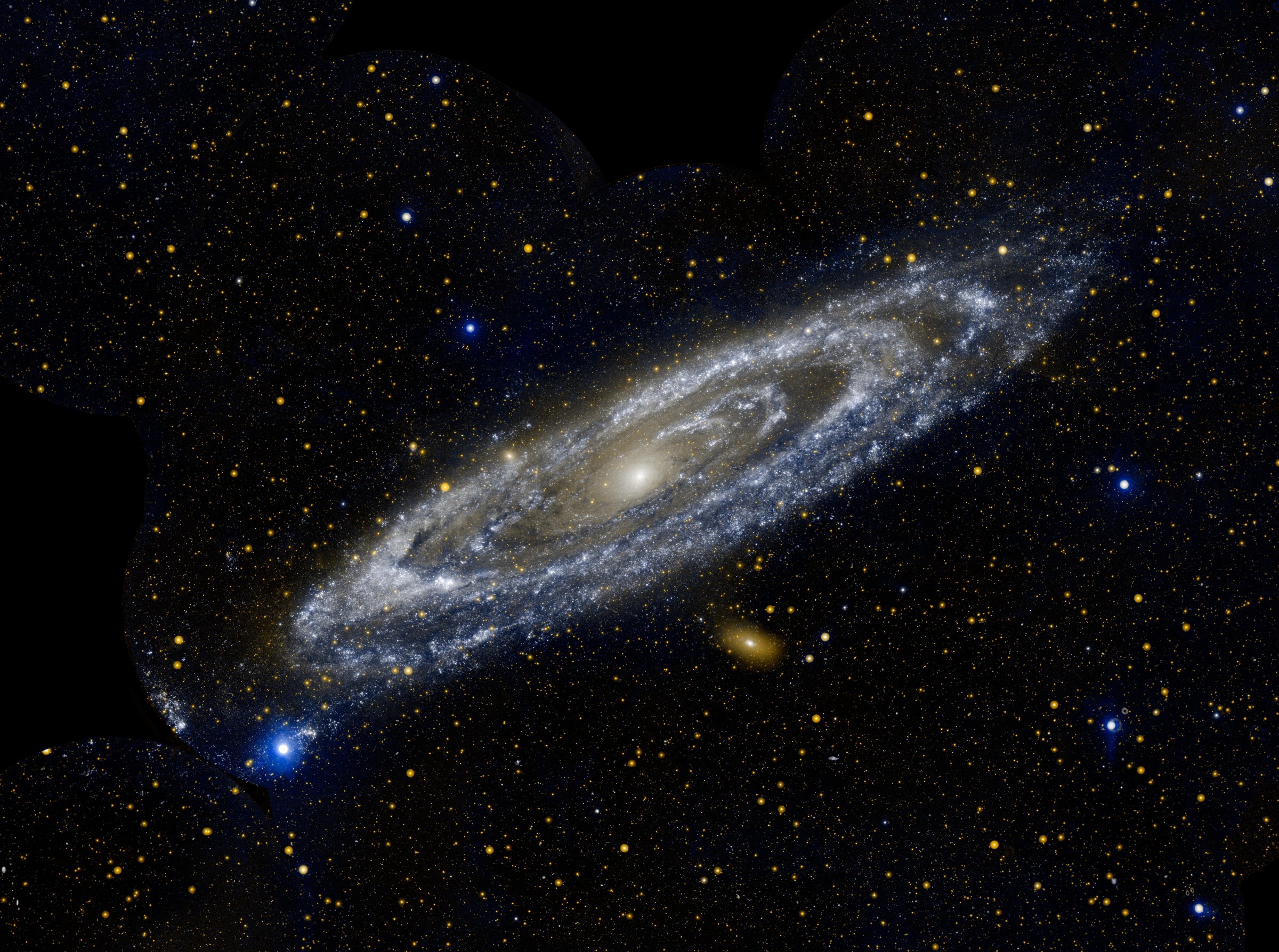
We see the Milky Way from the inside. Its faint band across a dark sky is the light of many stars along our line of sight through the disk. We cannot step outside it to take a face-on photograph of the whole galaxy. We can see Andromeda, or Messier 31 (M31), from the outside: it is a spiral in our Local Group about 2.5 million light-years away, according to NASA’s Hubble catalog.
How to look for Andromeda
Use a sky chart set to your location and date to find M31 in the constellation Andromeda. Autumn offers good opportunities from many Northern Hemisphere latitudes. Choose a clear night, get away from direct lighting, and look when the object is high above the horizon and moonlight is limited. Let your eyes adjust to the dark, try unaided first, and then use binoculars if you have them.
Look for a faint patch, often slightly elongated and brighter in the middle. Long-exposure images show details and colors the eye will not usually pick out. Write down the time, place, equipment, and sky conditions. If you cannot identify it, record that as well and try under different conditions.
Try reading two images
Pick two images from the references, one with a nearly face-on disk and one viewed at an angle. Write down what you can see, such as arms, a dark lane, or a bright center. Separately, note which galaxy type seems to fit. Then check the captions. If more than one explanation fits what you saw, note what further evidence would help you decide.
Start with M101, the Pinwheel Galaxy pictured in NASA’s guide to galaxy types, and the ultraviolet image of Andromeda at the top of this article. Compare their overall structure. The colors come from different observations.