

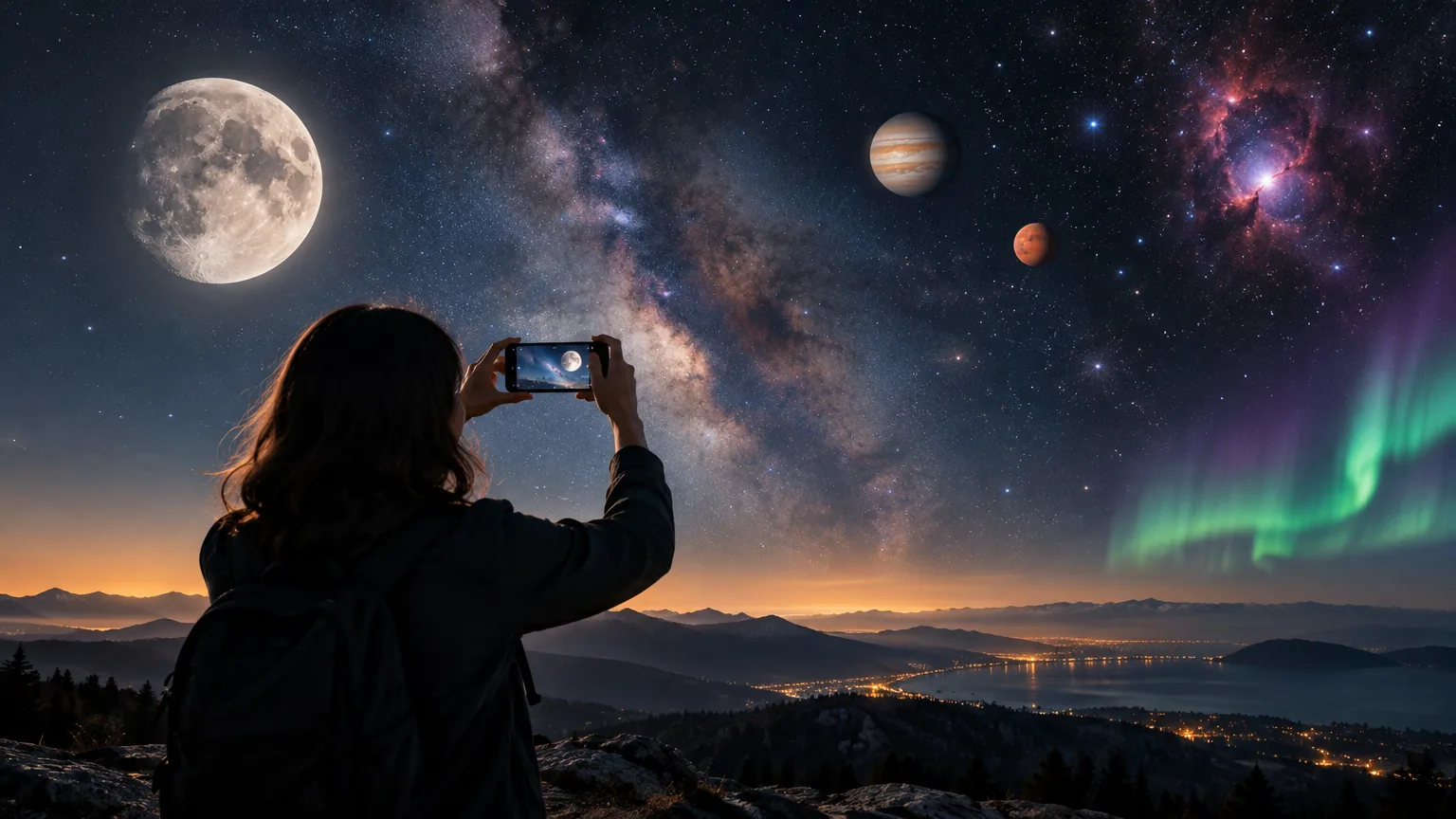
Key facts
- The guide was written by Dr. Sten Odenwald of the NASA Space Science Education Consortium at Goddard Space Flight Center.
- The document covers image calibration via gain correction, flat fielding, bias frames, and dark current.
- It includes techniques for photographing the Moon, planets, nebulae, galaxies, the Sun, eclipses, meteors, comets, satellites, and auroras.
- The guide is designed for Android and Apple devices and is classified for intermediate (6-8) and advanced (9-12+) educational levels.
- It recommends using stacking software and external gear like telescopes and telephoto lenses to improve image quality.
Related records
Camera and Light Fundamentals
The first step in smartphone astrophotography is understanding how light interacts with the camera sensor. The NASA guide explains basic concepts such as spectral response, pixel functionality, and controllable factors of the camera mechanism. These factors include aperture size, f-stop (relative aperture), exposure speed, and ISO. The document details how these parameters affect the amount of light captured and sensor sensitivity, as well as noise sources that can degrade image quality in low-light conditions.
Calibration and Data Processing
A crucial part of the workflow described in the guide is calibration. To obtain scientifically useful or aesthetically clean images, it is necessary to correct artifacts introduced by the hardware. NASA describes statistical and image techniques such as gain correction, flat fielding, the use of bias frames, and compensation for dark current. These processes allow for the removal of illumination variations and thermal noise, improving the fidelity of captured celestial details.
Celestial Targets and Specific Techniques
The guide offers practical instructions for photographing a wide variety of objects:
- Star fields and trails: Techniques for capturing fixed stars and creating star trails using tripods or intervalometers.
- The Moon: Methods for correctly exposing the lunar surface, which requires very different adjustments than deep sky due to its high brightness.
- Planets: Tips for capturing planetary details, often requiring telephoto lenses or telescopes.
- Deep sky: Guides for photographing nebulae like Orion (Messier 42), star clusters like the Pleiades, galaxies, and supernovae.
- The Sun and eclipses: Safety protocols and techniques for solar photography, including the use of broad-band and narrow-band filters, as well as capturing solar and lunar eclipses.
- Transient phenomena: Methods for photographing meteors, comets, artificial satellites (such as the International Space Station and Starlink constellations), and auroras.
External Gear and Software
Although the smartphone is the central device, the guide recommends the use of external gear to improve results. This includes telephoto lenses, binoculars, and telescopes. In the software realm, it covers everything from using the native camera's manual mode and low-light photography apps to third-party tools for stacking and image adjustment. Stacking is a fundamental technique in astrophotography that combines multiple shots to reduce noise and increase the signal-to-noise ratio.
Accessibility and Citizen Science
The guide also addresses astrophotography for people with visual impairments and connects users with citizen science projects. These projects allow photographs taken with smartphones to contribute to scientific research, such as monitoring nighttime light pollution or observing satellites. NASA emphasizes that this resource is free and designed to be accessible, including color photographs and equations that illustrate the science behind astrophotography.