

Key facts
- The study was published on October 29, 2026, in The Astrophysical Journal Letters.
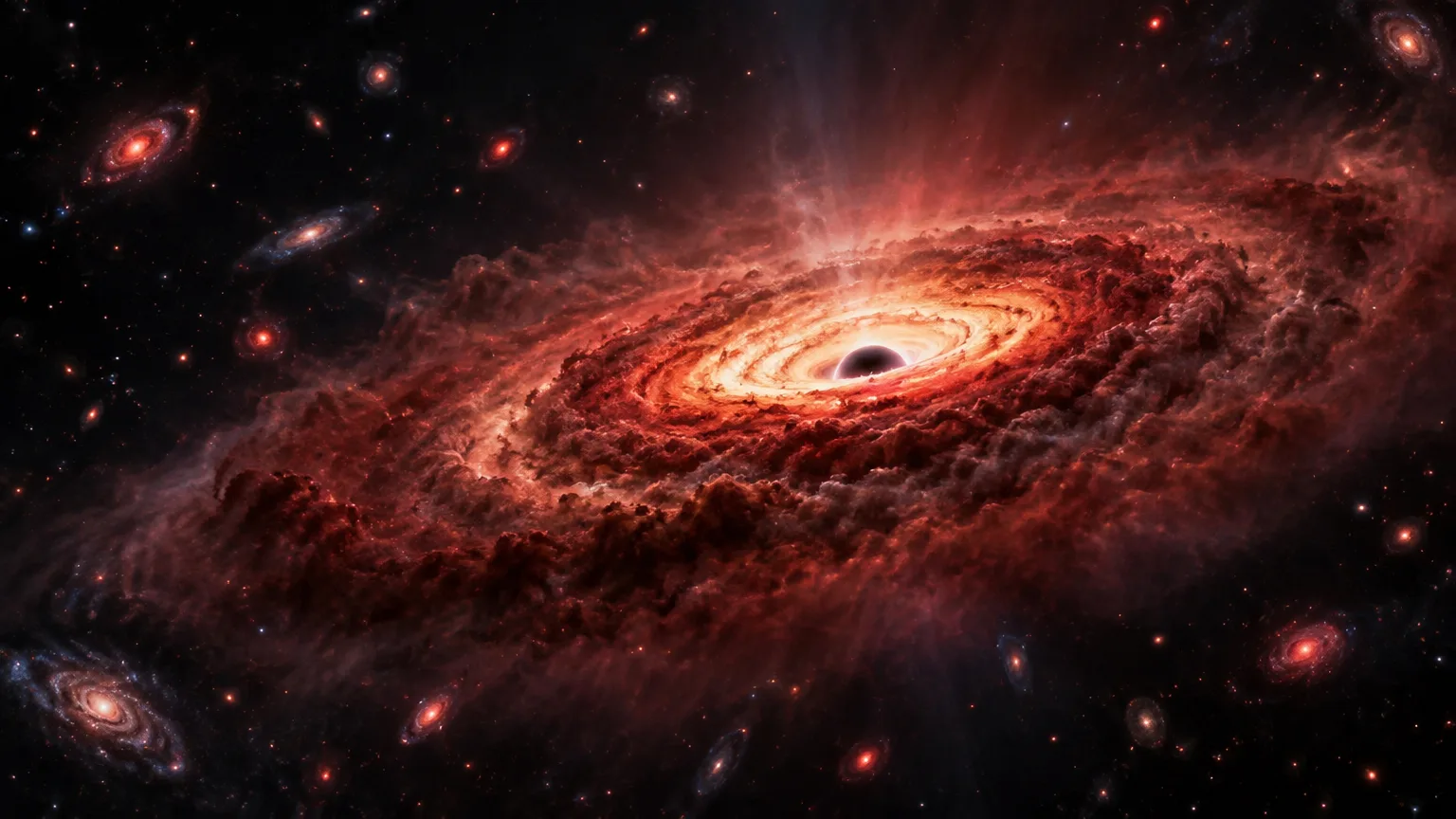
- The hypothesis proposes that LRDs are galaxies with direct-collapse black holes still enveloped by the disks that formed them.
- In the models, the disk’s dense gas traps X-rays and produces Balmer absorption features, while allowing some ultraviolet, optical, and reprocessed infrared radiation to escape.
- The simulated galaxy forms a star cluster near the black hole with a mass of about 10^8 solar masses and a radius of 150 parsecs.
- The simulated spectra are compared with RUBIES-EGS-42046, MoM-BH*-1, and CAPERS-LRD-z9.
Related records
“Little red dots” (LRDs) are compact, bright sources detected by the James Webb Space Telescope (JWST) in the early universe. Their spectra have a characteristic V shape, and some show hydrogen features that are difficult to explain with conventional models; they are also usually faint in X-rays. A study published on October 29, 2026, in The Astrophysical Journal Letters proposes that these properties can arise when a direct-collapse black hole remains enveloped by the massive gas disk that formed it.
The proposal comes from cosmological simulations that include radiative transfer. In this scenario, the very dense center of the disk absorbs and traps X-rays from the black hole. At the same time, some ultraviolet and optical radiation can escape, along with infrared light reprocessed by the gas. The calculations also produce Balmer absorption features, hydrogen-related signals seen in the spectra of some LRDs.
A black hole hidden in its birth disk
Direct collapse is a theoretical route to forming a massive black hole through the collapse of a supermassive primordial star. In the team’s model, the black hole does not become isolated after its birth: it remains surrounded by the accretion disk—the gas that rotates and falls toward the object—that took part in its formation. The authors propose that this dense envelope can hide the X-ray source without preventing some of its energy from escaping at other wavelengths.
To study the system, the work combines two modeling components. First, the researchers analyze a black hole inside an accretion disk of gas cooled by atomic processes and assess whether the disk can retain X-rays. They then calculate the spectrum produced by the disk’s very dense, ionized gas regions and compare it with those of different LRDs. The article notes that this configuration provides a lower limit on the possibility of X-ray escape: the disk and host halo may have accumulated more mass by the time the black hole reached the masses considered for these objects.
A compact star cluster beside the black hole
The explanation also seeks to reproduce the stellar population of the host galaxy. In the simulations, a dense cluster forms near the black hole, with a mass of approximately 108 solar masses and a radius of 150 parsecs. The authors consider these properties compatible with LRD observations.
The calculated spectra are compared with a range of sources: RUBIES-EGS-42046, described as a typical example; MoM-BH*-1, which has one of the most pronounced Balmer breaks; and CAPERS-LRD-z9, among the highest-redshift objects included in the analysis. The team says its models reproduce a broad range of LRD spectra.
An explanation that remains theoretical
Before this work, interpretations had been proposed based, among other possibilities, on compact stellar systems, highly obscured black holes, supermassive stars, and hypothetical objects called “black hole stars.” According to the authors, those scenarios had not jointly explained aspects such as LRD formation, the origin of the dense gas needed for some absorption features, and their inferred abundance or duration.
The study proposes that direct collapse can bring several of these elements together in a single framework: a persistent black hole, the dense disk that formed it, and a compact star cluster in the host galaxy. Its results, however, are an interpretation supported by simulations and spectral comparisons. The work presents the mechanism as a possible explanation for a range of LRDs, not as a definitive observational identification of all objects in this class.