

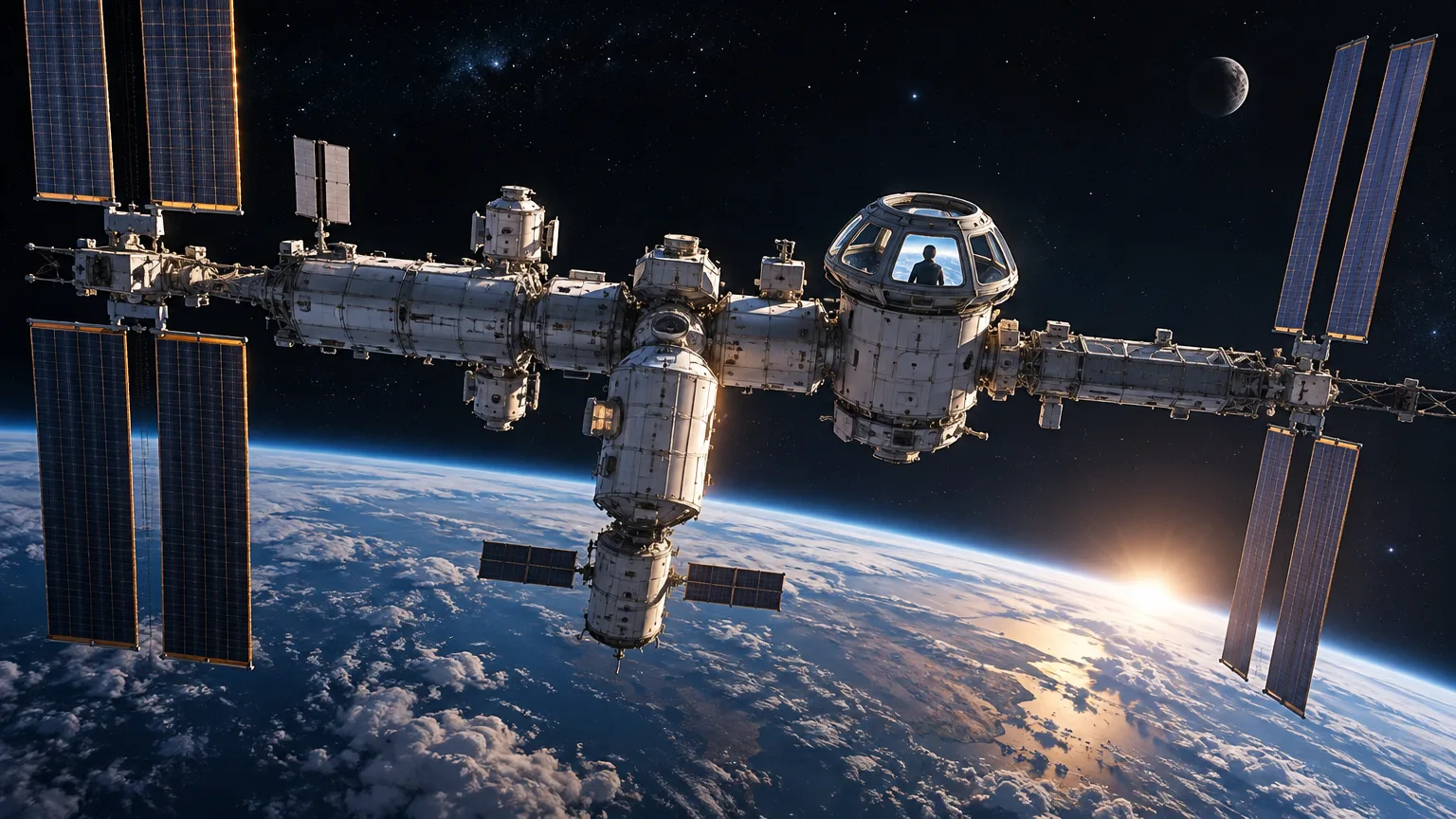
Key facts
- NASA published a tour of the station in Spanish in November 2023, presented by Frank Rubio; it begins in Harmony and includes the cupola.
- Frank Rubio served as a flight engineer on Expeditions 68 and 69 and spent 371 days in space during his first mission.
- The ISS is a microgravity laboratory and a modular complex with solar arrays and external robotic arms.
- The Kennedy Space Center source attributes the station’s management and operation to five space agencies representing 15 countries.
- Astronaut duties described include scientific experiments and station maintenance; life aboard includes exercise, foods that are sometimes rehydrated, and sleeping bags secured to crew quarters.
Related records
The International Space Station (ISS) is a modular complex orbiting Earth that functions as a microgravity laboratory. Microgravity makes it possible to study phenomena under conditions different from those usually experienced on Earth’s surface. The ISS is also a place where astronauts live and work during their missions.
One way to get a sense of its interior is to watch the tour in Spanish that NASA published in November 2023, presented by astronaut Frank Rubio. The tour begins in Harmony and travels through the station to the cupola, an area with windows offering views of Earth. Rubio served as a flight engineer on Expeditions 68 and 69 and spent 371 days in space during his first mission.
A complex of modules and systems
The station is made up of modules connected to one another. These spaces form the habitable and working complex, while other components enable it to operate. The Kennedy Space Center’s description mentions solar arrays connected by a truss structure and robotic arms installed on the exterior.
The modular layout helps explain why the ISS is not a single room but a collection of integrated spaces and equipment. Rubio’s tour offers a guided look at part of this complex, from Harmony to the cupola.
A laboratory in orbit
Scientific research is one of the station’s central functions. In its description of the ISS, the Kennedy Space Center presents it as a microgravity laboratory where researchers from different countries conduct experiments. International collaboration is also part of its management: that source attributes the station’s operation to five space agencies representing 15 countries.
Microgravity conditions make it possible to conduct research in an orbital environment. The information presented here does not detail specific experiments, so this guide focuses on the station’s general role as a platform for research and cooperation.
What astronauts do and how they live
Crew duties include conducting scientific experiments and maintaining the station. Daily life is also organized around the needs of staying in orbit: the Kennedy Space Center mentions daily exercise, foods that sometimes need to be rehydrated, and sleeping bags secured to crew quarters.
The ISS thus combines scientific and technical activities with the routines required to live and work aboard. Its continued operation depends both on the complex’s equipment and on the work of the people who inhabit and maintain it.
A shared mission
The International Space Station represents collaboration among space agencies from several countries. According to the Kennedy Space Center source, five agencies representing 15 countries take part in its management and operation. This cooperation makes it possible to operate a shared facility devoted to research and human presence in space.
For a visual look at some of its spaces, the NASA tour presented by Frank Rubio offers an introduction in Spanish to the station’s interior. It complements the essential idea: the ISS is at once a complex of modules, a microgravity laboratory, and a place where a crew conducts research and maintenance.