

Key facts
- NASA states that anyone can do astrophotography with a smartphone.
- Stability is crucial; a tripod or improvised supports are recommended to avoid vibrations.
- Automatic focus must be manually locked by tapping the screen on a bright reference.
- It is recommended to start with exposure times of a few seconds.
- Post-processing is essential to enhance details in astronomical images.
- Adapters can be used to connect the phone to a telescope eyepiece.
Related records
Smartphone astrophotography is no longer an expert privilege. According to NASA, anyone with a camera can photograph astronomical objects, although deep sky objects may require hours, expensive equipment, and travel. The key to surprising results lies not in cutting-edge hardware, but in mastering four basic techniques: stability, focus lock, long exposure, and processing.
The importance of mechanical stability
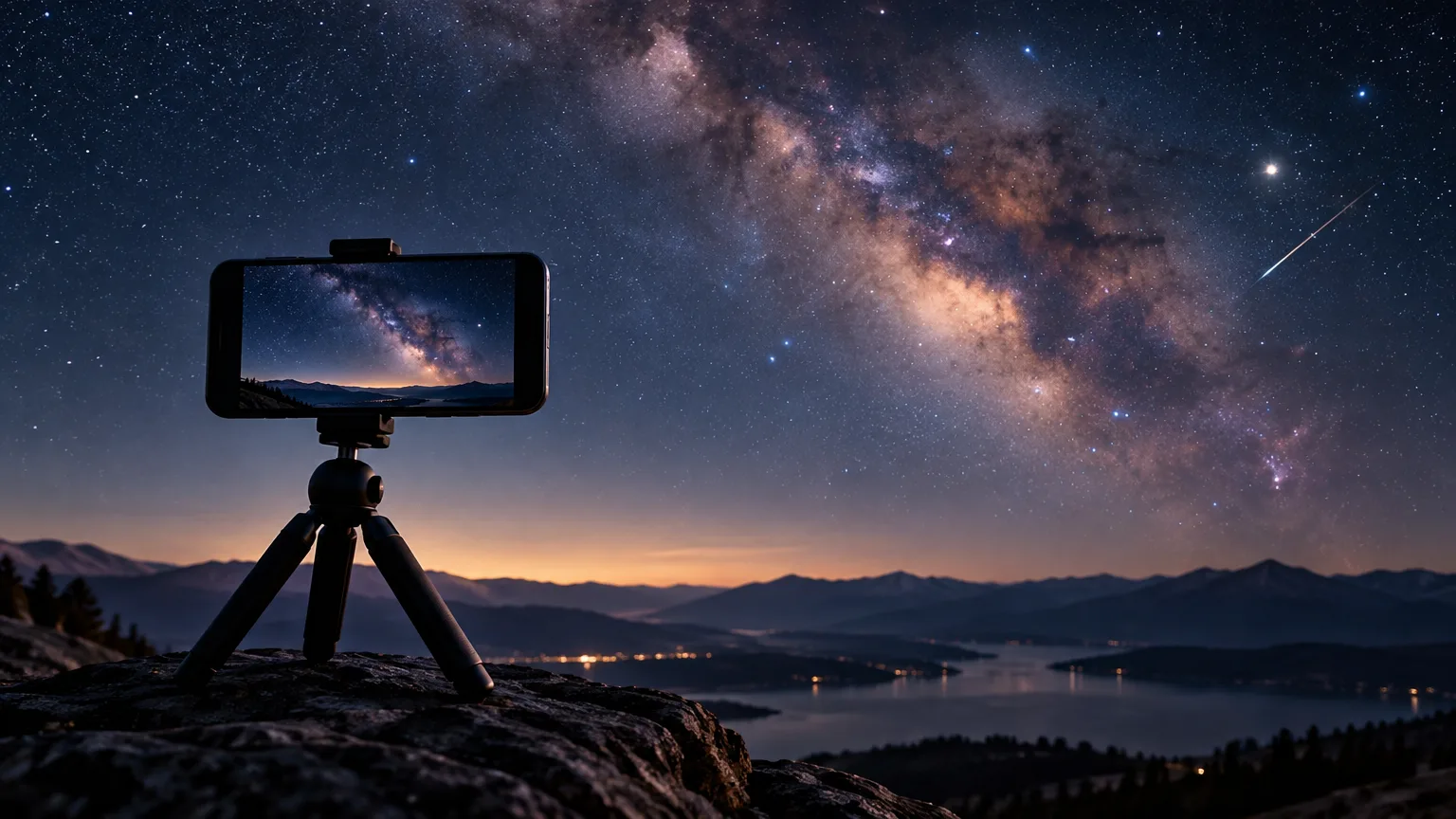
The first critical step is ensuring the smartphone is stable. In low light conditions, any vibration can ruin image sharpness. NASA recommends using a small tripod, though in a pinch, improvised supports like a rock or a wooden block can work. Additionally, most camera apps offer a timer that delays capture by a few seconds, reducing vibration caused by fingers pressing the button.
Manual focus control
Smartphone automatic focus is not ideal for astrophotography, as the camera may readjust focus mid-session. To prevent this, you must tap the screen to focus on a bright reference, such as a distant star or a streetlight, and then use the app options to refine and lock the focus manually. This step is essential to maintain sharpness during long exposures.
Exposure time adjustment
Exposure is the factor that determines how much light the sensor collects. The longer the shutter is open, the more clarity is captured. The NASA guide suggests starting by setting the exposure time to a few seconds. If the native app does not allow this control, third-party apps offering manual exposure adjustments can be downloaded.
Post-processing and additional resources
Post-processing is described by NASA as the "secret of all astrophotography". Using an app or computer program to enhance additional details is fundamental to revealing the structure of celestial objects. Additionally, adapters can be used to mount the phone on a telescope eyepiece, allowing astronomical targets to be photographed with greater detail or to share the live view. NASA offers a free e-book and a smartphone astrophotography project for those who wish to delve deeper into these techniques.