

Key facts
- NASA published the guide "A Guide to Smartphone Astrophotography" to teach mobile device use in astrophotography.
- Calibration includes gain correction, flat fielding, bias frames, and dark current compensation.
- The guide covers photographing the Moon, planets, nebulae, auroras, and artificial satellites.
- Use of telephoto lenses, binoculars, or telescopes with the smartphone is recommended.
- Citizen‑science projects such as Globe at Night and Satellite Streak Watcher are included.
Related records
Optical Fundamentals and Sensor Response
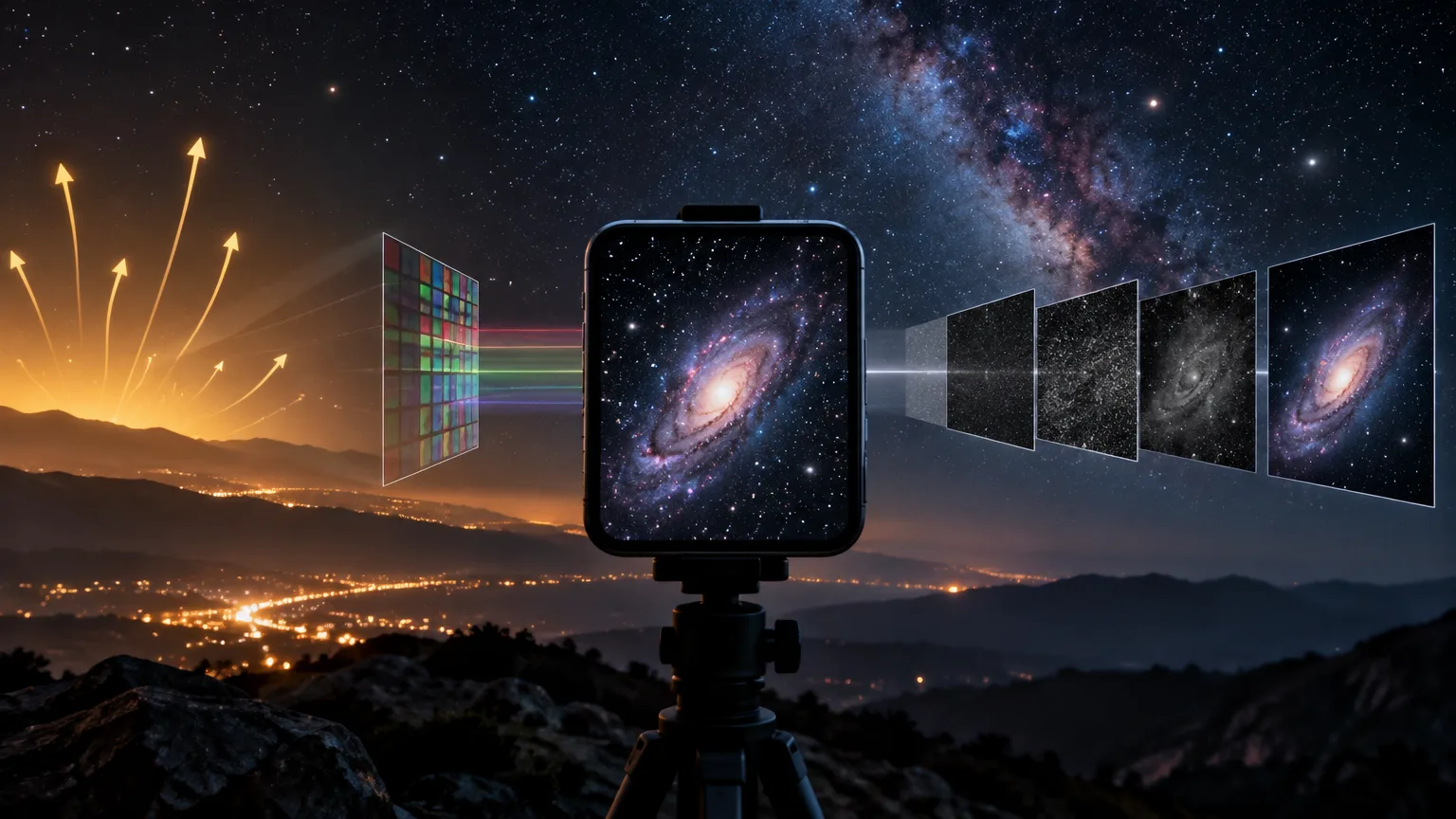
The guide establishes that the quality of an astronomical image depends on understanding the spectral response of the camera and how its sensors operate. It explains how pixels capture photons and how controllable factors such as aperture, exposure time, and ISO determine the amount of light recorded. The relationship between these parameters and the appearance of noise, a critical factor in low‑light photography, is detailed. Section 2.0 of the document’s index dedicates subsections to basic definition, spectral response, sensor operation, and camera mechanisms, including aperture, f‑number, exposure time, and ISO.
Statistical Calibration Process
A central section, 3.0, is devoted to "The art of calibration and why it works". This process uses statistical principles to enhance signal and reduce noise. The guide describes specific techniques such as:
- Gain correction and flat fielding to homogenize sensor response.
- The use of bias frames (bias frames) to measure the baseline electronic signal.
- Compensation for dark current (dark current), the signal generated by the sensor in darkness.
These steps are essential for obtaining clean images of faint objects, as they separate real astronomical signal from hardware imperfections.
Targets and Specific Techniques
The document’s index confirms sections dedicated to photographing a wide range of astronomical targets, including:
- Solar System objects: the Moon, planets, solar and lunar eclipses.
- Deep sky: nebulae (e.g., Orion Nebula, Messier 42), star clusters (e.g., Pleiades), and galaxies.
- Transient phenomena: meteors, comets, auroras.
- Artificial objects: satellites, including the International Space Station and constellations such as Starlink.
To improve results, the guide includes sections on using external equipment such as telephoto lenses, binoculars, or telescopes, and intervalometers for sequential captures that can later be stacked.
Community and Citizen Science
Beyond technique, the guide encourages participation in citizen‑science projects. Initiatives such as Globe at Night, which allows users to measure local light pollution, and Satellite Streak Watcher, for tracking satellite passes, are mentioned. These projects link photographic practice with global scientific research.