

Key facts
- The campaign was conducted at the P5 stand in Lampoldshausen, operated by DLR.
- Prometheus uses liquid methane and oxygen and is developed by ArianeGroup on behalf of the ESA.
- The modernization allows studying consecutive ignitions and thrust changes.
- Ground tests provide data for future reusable propulsion systems.
Related records
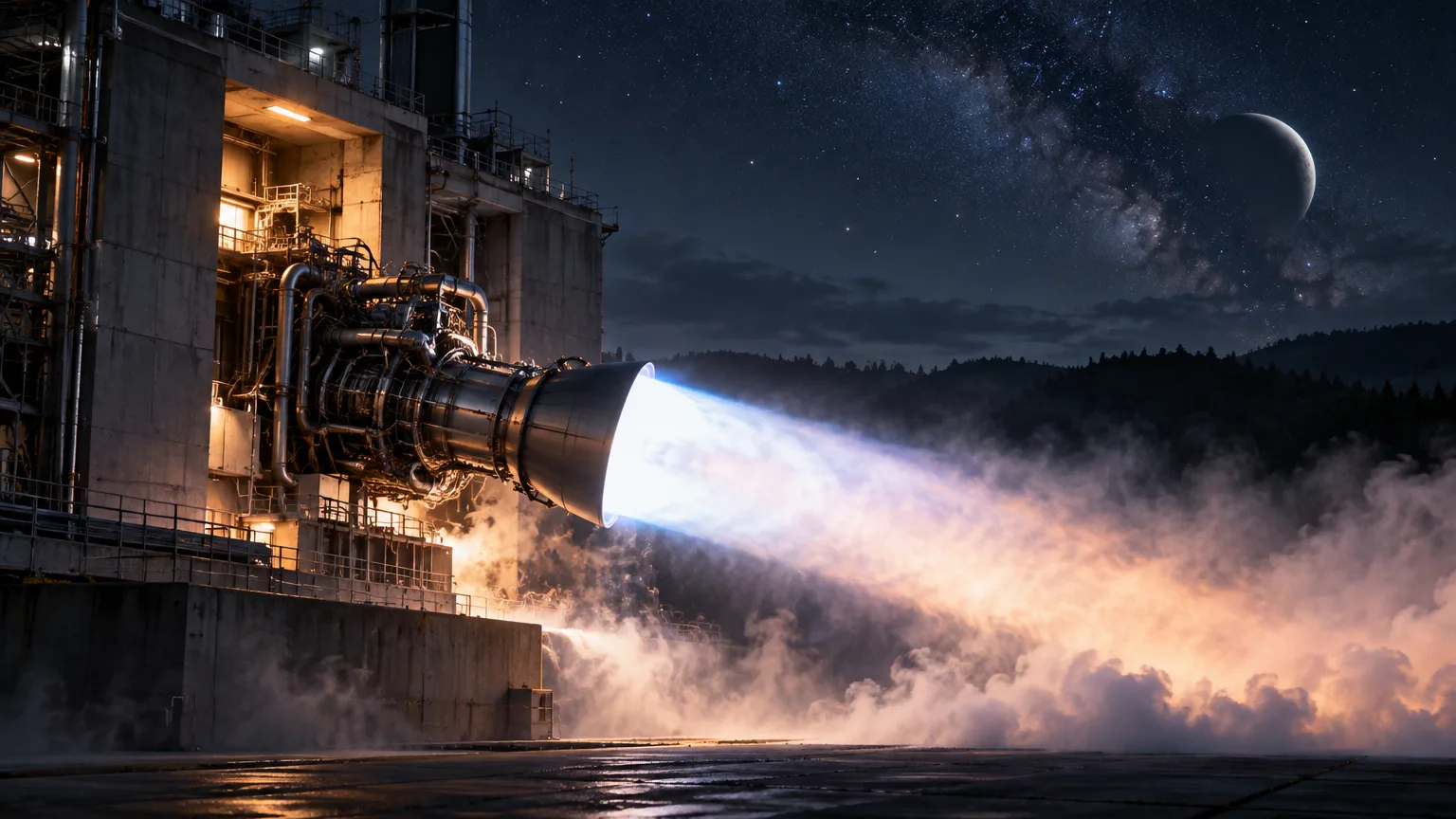
The German Aerospace Center (DLR) tested the Prometheus engine at the modernized P5 stand in Lampoldshausen, Baden-Wurtemberg. For the first time in the history of that facility, an engine fueled with liquid methane and oxygen was ignited several times during a single day and maintained stable operating points within a continuous test sequence.
The campaign builds on previous tests conducted at ArianeGroup's facility in Vernon, France. Prometheus is being developed by ArianeGroup on behalf of the European Space Agency (ESA), while DLR operates P5 as part of the European agency's test infrastructure.
A stand prepared for more complex sequences
The modernization of P5 allows work with liquid methane and consecutive ignitions. The stand supplies the engine with the necessary propellants and gases and establishes pressure and temperature conditions. Its instruments record thrust, propellant flows, pressure ratios, and temperatures to analyze both the engine's behavior and that of the facility.
After each hot ignition, the engine and its feed systems must be safely shut down and prepared for the next start. The procedure includes draining and purging the systems, as well as restoring pressure and temperature conditions. DLR highlights the coordination required to perform these operations in an automated and reproducible manner.
Re-ignition and thrust adjustment
An engine intended for a reusable stage may need to shut down after launch and re-ignite for return or landing maneuvers. It must also regulate its thrust according to the flight phase. The updated stand allows studying different power levels and the transitions between them under controlled conditions.
Researchers can examine the engine's stability, its response to rapid thrust changes, and the resulting thermal and mechanical loads. The data from this campaign will be used to continue the development and testing of Prometheus; these are ground tests, not a demonstration of stage recovery in flight.
Liquid methane and oxygen
Prometheus belongs to the class of engines with approximately 100 tons of thrust and uses liquid methane and oxygen. Compared to liquid hydrogen, methane has higher density and can be stored at higher temperatures, simplifying the design and handling of tanks and feed systems. Its development is part of the ESA's preparatory program for future launchers, known as FLPP.